
Sensory Properties and Microbial Safety of Smoked Clarias gariepinus in Four Markets in Southwest Nigeria
-
F.P.D. Satimehin
Department of Aquaculture and Fisheries Management, University of Ibadan, Ibadan, Oyo State, Nigeria
K.J. AwobodeDepartment of Aquaculture and Fisheries Management, University of Ibadan, Ibadan, Oyo State, Nigeria
F.E. OlanrewajuDepartment of Aquaculture and Fisheries Management, University of Ibadan, Ibadan, Oyo State, Nigeria
I.S. Ogah
Department of Aquaculture and Fisheries Management, University of Ibadan, Ibadan, Oyo State, Nigeria
| Received 05 Oct, 2025 |
Accepted 12 Jan, 2026 |
Published 31 Mar, 2026 |
Background and Objective: Smoked catfish (Clarias gariepinus) is a widely consumed and affordable protein source in Nigeria; however, its sensory quality and microbial safety are often compromised due to poor handling and processing conditions. This study aimed to evaluate the sensory attributes and microbial safety of smoked catfish sold in four major markets Bodija, Oje, Sango, and Gbaremu in Ibadan North Local Government Area, Southwest Nigeria. Materials and Methods: A total of 120 smoked catfish samples were collected over six weeks and evaluated by trained panelists from the Department of Aquaculture and Fisheries Management, University of Ibadan. Sensory attributes such as taste, colour, and texture were assessed using a 9-point hedonic scale. Microbial analyses were conducted to determine bacterial and fungal loads, including the presence of pathogens such as Escherichia coli and Salmonella spp. Data obtained were analyzed using descriptive statistics and analysis of variance (ANOVA) to identify significant differences (p<0.05) among market samples. Results: Samples from Bodija market recorded the highest sensory scores, particularly for taste and texture, while those from Sango market exhibited the highest bacterial contamination levels exceeding acceptable safety limits. Fungal isolates, including Aspergillus niger, were also prevalent across all markets. Significant differences (p<0.05) were observed in microbial counts among the sampled markets. Conclusion: The study concludes that although smoked catfish from Ibadan markets generally meets consumer taste expectations, microbial contamination poses a serious health concern due to inadequate handling and storage. Improved smoking techniques, hygienic handling, and stricter enforcement of food safety regulations are recommended to ensure product safety, consumer satisfaction, and the sustainability of the smoked catfish trade in Nigeria.
| Copyright © 2026 Satimehin et al. This is an open-access article distributed under the Creative Commons Attribution License, which permits unrestricted use, distribution, and reproduction in any medium, provided the original work is properly cited. |
INTRODUCTION
Fisheries resources play a crucial role in providing wealth, health, food, and nutrition, particularly in communities where these resources are abundant1. Globally, fish constitutes about 60% of the world’s protein supply, and developing countries derive more than 30% of their annual protein intake from fish2. Fish is widely recognized as one of the most affordable sources of high-quality animal protein, delivering essential nutrients necessary for human health. Its increasing role in global diets can be attributed to its availability, palatability, and numerous health benefits3,4.
In Nigeria, fish is a significant part of the daily diet, with smoked catfish (Clarias gariepinus) being a popular and affordable food item consumed across the country5. The growing demand for fish products in Nigeria is fuelled by their nutritional benefits and the country’s increasing population, making the fish industry a vital source of income and employment, especially in the fishing and processing sectors6-8.
Despite the popularity of smoked catfish, there is limited research on its sensory attributes and quality in different local markets. The sensory characteristics of fish, including its taste, texture, and appearance, are critical to consumer satisfaction and can significantly influence purchasing decisions. Therefore, assessing these attributes is vital for ensuring that smoked catfish meets the expectations of consumers and sustains the industry. Additionally, understanding how factors such as smoking techniques, storage practices, and market handling influence product quality is key to enhancing consumer acceptance and improving the economic viability of the smoked catfish market.
In parallel, concerns regarding the microbiological safety of smoked fish have been raised, particularly in markets with less regulated processing and handling practices9. The smoking process is an age-old preservation method that extends the shelf life of fish by reducing water activity, improving flavour, and inhibiting microbial growth10. However, its effectiveness is highly dependent on the smoking temperature, duration, and hygiene conditions under which the process is conducted. Poor handling and unsanitary conditions during smoking and post-processing can lead to microbial contamination, posing significant health risks to consumers11.
Previous studies have identified the presence of harmful microorganisms, including Staphylococcus aureus, Escherichia coli, Salmonella spp., Proteus, Bacillus, and Listeria monocytogenes, in smoked fish from various regions of Nigeria, highlighting the need for ongoing monitoring of microbiological safety in these products12,13. The World Health Organization (WHO) also cautions that improper handling and inadequate hygiene during the smoking and storage processes can lead to severe health risks for consumers14.
Given the importance of both the sensory quality and microbiological safety of smoked catfish, this study aims to provide an assessment of the product sold in four major markets within the Ibadan North Local Government Area. Specifically, this research will evaluate the sensory qualities of smoked catfish, focusing on parameters such as taste, texture, colour, tenderness, and overall acceptability, while also investigating the microbiological load of smoked catfish, identifying bacterial and fungal species present, and assessing the levels of key pathogens, such as Escherichia coli and Salmonella spp., against national and international standards.
MATERIALS AND METHODS
Study area: Ibadan North Local Government Area is situated in Oyo State, Southwestern Nigeria. The study was carried out between March and June, 2024. The LGA covers an area of approximately 486 square kilometres and is one of the 33 LGAs that make up the state. Ibadan North LGA includes several bustling markets that are central to the local economy. For this study, smoked Clarias gariepinus (African catfish) samples were sourced from four major markets: Bodija (M1), Oje (M2), Sango (M3), and Gbaremu (M4).
Bodija market (M1), located at Latitude 7.4351°N and Longitude 3.9143°E, is a prominent and diverse commercial hub. It caters to a wide range of consumer needs, offering agricultural products, household goods, and other commodities.
Oje market (M2), located at Latitude 7.3381°N and Longitude 3.0983°E, is one of the oldest markets in Ibadan, known for its trade in traditional weaving materials, fruits, and food items.
Sango market (M3), situated at Latitude 7.4219°N and Longitude 3.8975°E, is a dynamic marketplace that draws both wholesale and retail traders for food items and other goods.
Gbaremu market (M4), positioned at Latitude 7.4231°N and Longitude 3.8810°E, is known for its wide variety of products, including fresh produce, clothing, and household items.
These markets were chosen for their economic significance and the diversity of products they offer, particularly smoked catfish, which is a popular food item in the region.
Sample collection: Approximately 200 g of smoked Clarias gariepinus were purchased from randomly selected vendors at each market (M1-M4) to represent typical market samples. Samples were collected over eight weeks, with four samples per market, resulting in a total of forty samples. The samples were collected in sterile, zip-locked containers to prevent contamination and were labelled accordingly (M1 for Bodija, M2 for Oje, M3 for Sango, and M4 for Gbaremu). Samples were transported to the laboratory on the same day and stored at 4°C before analysis.
Sensory (organoleptic) assessment: Sensory evaluation was conducted15, with modifications to suit smoked fish products. A trained panel of five assessors from the Department of Aquaculture and Fisheries Management, University of Ibadan, participated in the sensory evaluation. Before the study, the assessors underwent training to ensure consistency in evaluating sensory parameters, including taste, colour, texture, tenderness, juiciness, and overall acceptability of the smoked catfish. The sensory evaluation was carried out under controlled conditions, and samples were coded with random numbers to avoid bias. The panellists used a 9-point hedonic scale (ranging from 1 = dislike extremely to 9 = like extremely) to rate each parameter. Between evaluations, panellists were instructed to cleanse their palates with potable water to prevent cross-sample contamination.
Microbiological analysis: Microbiological analysis was conducted to evaluate the quality and safety of smoked catfish samples from the selected markets. All microbiological assays were performed according to standard methods as described by the International Organization for Standardization (ISO) and the American Public Health Association16.
Total fungal count (TFC): The total fungal count was determined using Potato Dextrose Agar (PDA) supplemented with lactic acid to inhibit bacterial growth17. Serial dilutions of the samples were prepared in sterile 0.1% peptone water. A 0.1 mL aliquot of each dilution was spread onto pre-dried PDA plates. Plates were incubated at 25°C for five days, and fungal colonies were counted and reported as colony-forming units per gram (CFU/g).
Total bacterial count (TBC): The total bacterial count was determined using the pour plate method (ISO 4833-1:2013). Serially diluted samples were inoculated into Plate Count Agar (PCA) and incubated at 35°C and 37°C for 24 hrs. Colonies were counted and recorded as CFU/g.
Detection of Salmonella spp.: The presence of Salmonella spp. was tested following the method described in ISO 6579-1:2017. Samples were pre-enriched in Buffered Peptone Water (BPW) and incubated at 37°C for 24 hrs. Enrichment was then done in Selenite Cystine Broth, followed by selective plating on Salmonella-Shigella (SS) agar. Black colonies indicative of Salmonella were confirmed using biochemical tests.
Detection of Escherichia coli: The presence of E. coli was determined using the Most Probable Number (MPN) method, following ISO 16649-1:2001. Positive tubes were incubated in tryptone water at 44°C for 24 hrs, and indole production was confirmed using Kovac's reagent.
Detection of Staphylococcus aureus: Staphylococcus aureus was detected using Baird-Parker Agar, following the method described by ISO 6888-1:2021. Samples were inoculated on Baird-Parker agar and incubated at 35°C-37°C for 48 hrs. Colonies were subjected to coagulase testing for confirmation.
Statistical analysis: All sensory and microbiological data were statistically analysed using SPSS version 27.0. One-way Analysis of Variance (ANOVA) was used to determine significant differences between markets, with a significance level set at p<0.05. Where significant differences were detected, Duncan’s multiple range test was used to separate means. Results were expressed as Means±Standard Deviation (SD).
RESULTS
Microbial counts of smoked catfish samples: The mean microbial counts (expressed as Log CFU/g of catfish samples) for total bacteria, fungi, Staphylococcus spp., Enterobacteriaceae, E. coli, and Salmonella/Shigella derived from smoked catfish obtained from four major markets within Ibadan North Local Government are presented in Table 1. The total bacterial count (TBC) ranged from 1.51 to 2.71 Log CFU/g, with the highest bacterial load detected in samples from Sango market (2.71×10⁶ CFU/g), and the lowest in Oje market (1.51×10⁶ CFU/g). This exceeds the recommended standards for microbial load in smoked fish, highlighting significant discrepancies across markets. The total fungal count (TFC) ranged from 0.06 to 0.16 Log CFU/g, with the highest fungal contamination observed in Bodija market (0.16×10³ CFU/g) and the lowest in Oje market (0.06×10³ CFU/g). The Salmonella/Shigella contamination was most prevalent in the Sango market (1.16×101 CFU/g), while the Bodija market had the lowest contamination level (0.33×101 CFU/g). Staphylococcus count ranged from 3.66 to 5.83 Log CFU/g, with Oje market recording the highest contamination (5.83×101 CFU/g) and Sango market the lowest (3.66×101 CFU/g). Enterobacteriaceae count peaked in Bodija market (0.88×10² CFU/g) and was lowest in Sango market (0.68×10² CFU/g). The total E. coli count ranged from 0.33×101 to 1.00×101 CFU/g, with the highest levels in the Sango market and the lowest in the Oje market.
Significant differences between markets: Statistical analysis showed significant differences (p<0.05) between markets for microbial contamination levels, particularly for TBC and other groups. Bodija, Sango, and Gbaremu markets did not differ significantly (p>0.05) in their TBC values. However, Oje market’s TBC was significantly lower (p<0.05). For other microbial groups (TFC, TSC, TEC, TSSC), there were no significant differences (p>0.05) among the markets, indicating relatively uniform contamination across the locations.
| Table 1: | Microbial counts of smoked fish samples | |||
| Market | Recommended standard limit |
|||||
| Microbial load | Bodija (M1) | Oje (M2) | Sango (M3) | Gbaremu (M4) | FDA | ICMSF |
| T.B.C. (×106 CFU/g) | 2.28±0.31b | 1.51±0.31a | 2.71±0.56b | 2.21±0.55b | ×105 | ×105 |
| T.F.C. (×103 CFU/g) | 0.16±0.15a | 0.06±0.07a | 0.14±0.13a | 0.08±0.06a | ×103 | ×104 |
| T.S.C. (×101 CFU/g) | 4.50±2.58a | 5.83±1.60a | 3.66±1.36a | 4.66±1.63a | ×103 | ×103 |
| T.E.C. (×102 CFU/g) | 0.88±0.77a | 0.70±0.80a | 0.68±0.82a | 0.78±0.61a | ×102 | ×104 |
| T.E.C.C. (×101 CFU/g) | 0.50±0.83a | 0.33±0.81a | 1.00±1.26a | 0.50±1.25a | ×102 | ×102 |
| T.S.S.C. (×101 CFU/g) | 0.33±0.81a | 0.83±1.32a | 1.16±1.47a | 0.50±0.83a | 0 | 0 |
| Means values within a row after the symbol‘±’represent standard deviations, and the same alphabets on the superscripts represent no significant difference (p<0.05), T.B.C.: Total bacteria count, T.F.C.: Total fungi count, T.S.C.: Total staphylococcus count, T.E.C.: Total enterobacteriaceae count, T.E.C.C.: Total E. coli count and T.S.S.C.: Total salmonella shigella count | ||||||
|
|
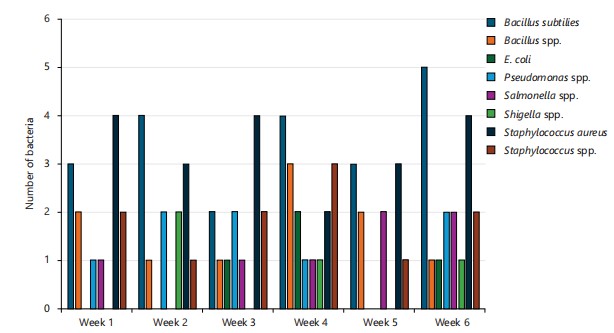
Frequency of bacterial isolates: Figure 1 displays the weekly distribution of bacterial isolates in the smoked catfish samples across six weeks of analysis. The identified bacteria included Bacillus subtilis, Staphylococcus aureus, Pseudomonas spp., Salmonella spp., and Shigella spp. Over the course of the study, Bacillus subtilis was consistently detected across all weeks, showing the highest prevalence in week 6. Staphylococcus aureus was predominant in weeks 1, 2, and 6, while Salmonella spp. appeared frequently in weeks 5 and 6. Pseudomonas spp. was most prevalent in weeks 2, 3, and 6.
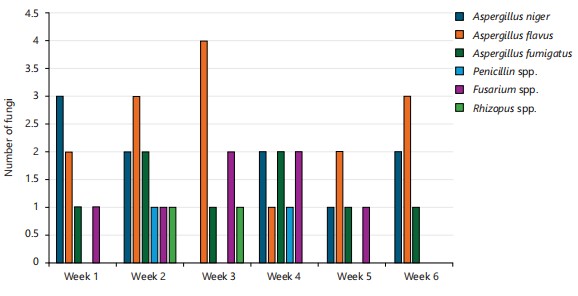
Frequency of fungal isolates: Figure 2 outlines the frequency of fungi isolated from the catfish samples over the six weeks. The identified fungi include Aspergillus niger, A. flavus, A. fumigatus, Penicillium spp., Fusarium spp., and Rhizopus spp. Aspergillus niger was the most consistently detected species across all six weeks, with the highest frequency in week 1 and no presence in week 3. A. flavus exhibited the highest occurrence in week 3 and the lowest in week 4. Penicillium spp. appeared only in weeks 2 and 4. Fusarium spp., was detected consistently in the first five weeks, with its highest occurrence in weeks 3 and 4.
| Table 2: | Sensory characteristics of the smoked fish samples | |||
| Treatment | ||||
| Characteristics | Market 1 | Market 2 | Market 3 | Market 4 |
| Tenderness | 6.76±2.11b | 6.30±1.93b | 5.90±1.80ab | 5.10±2.20a |
| Flavour/taste | 6.43±2.51a | 6.23±1.95a | 5.23±2.32a | 5.50±2.04a |
| Colour | 6.46±2.06a | 6.23±1.61a | 5.63±1.93a | 5.90±1.66a |
| Juiciness | 6.43±2.35b | 6.20±1.98b | 5.40±2.04ab | 4.86±2.33a |
| Texture | 6.70±2.07b | 6.40±1.75b | 5.63±2.14ab | 5.63±2.26a |
| Overall acceptability | 6.50±2.43c | 6.23±2.09bc | 4.93±2.43ab | 5.20±2.21a |
| Means within a row with different superscripts are significantly different at p<0.05 | ||||
Sensory evaluation of smoked catfish samples: Table 2 presents the sensory evaluation results of smoked catfish samples from the four markets. The panellists rated tenderness, flavour, colour, juiciness, texture, and overall acceptability using a 9-point hedonic scale. For tenderness, Market 1 samples had the highest tenderness score (6.76±2.11), significantly preferred over Market 4 (5.10±2.20), which had the lowest tenderness score. In terms of flavour, Market 1 (6.43±2.51) and Market 2 (6.23±1.95) samples were rated highest for flavour, while Market 3 had the lowest score (5.23±2.32), but no significant differences were noted among the samples. Market 1 had the highest colour rating (6.46±2.06), with Market 3 having the lowest (5.63±1.93). For juiciness, Market 1 samples were rated highest (6.43±2.35), while Market 4 samples received the lowest juiciness score (4.86±2.33), with a significant difference. Market 1 samples had the highest texture score (6.70±2.07), and samples from Market 3 and Market 4 were rated lowest (5.63±2.14 and 5.63±2.26, respectively). For Overall Acceptability, Market 1 samples were the most preferred (6.50±2.43), with a significant difference compared to the other markets. Market 3 samples had the lowest overall acceptability score (4.93±2.43), indicating the least preference among panellists.
DISCUSSION
The results from the assessment of the sensory properties and microbial safety of smoked catfish (Clarias gariepinus) in Ibadan-North markets provide significant insights regarding both public health and product acceptability. These findings, when contextualized within recent peer-reviewed literature, highlight the interplay between processing methods, ingredient treatments, storage, and safety.
Sensory properties such as taste, colour, texture, and overall acceptability play a critical role in consumer preference for smoked catfish. In the present results, proximate analyses and pH measurement confirmed minimal loss of nutritional quality after smoking, with protein, fat, and ash remaining relatively stable. This agrees with recent work showing that though moisture content is reduced by smoking, the sensory attributes, especially texture and colour, are often improved, resulting in better consumer acceptability18. In similar studies, trained panels found that fish smoked in improved and well-managed kilns or with appropriate pre-treatments maintained favourable sensory characteristics after several weeks of storage19,20.
Moreover, brining and ascorbic acid treatments contributed to sensory quality by reducing spoilage, thus preserving the “fresh” flavour profile and desirable texture for up to eight weeks of storage. Catfish treated with appropriate concentrations of NaCl and ascorbic acid, especially when combined with efficient firewood or charcoal smoking, not only slowed microbial growth but also maintained sensory scores comparable to freshly smoked products for several weeks. This is supported by emerging findings that ascorbic acid addition positively impacts both preservation and consumer perception of smoked fish21.
Microbial safety remains central to smoked fish shelf life. The researcher’s findings showed a characteristic trend: Negligible fungal and pathogenic bacteria at weeks 0-6, with a marked increase by week 8, particularly in untreated samples and those smoked without brine or ascorbic acid. The dominant isolates
including Salmonella spp., E. coli, Streptococcus spp., and Clostridium botulinum-highlight the persistence of foodborne hazards in inadequately processed or stored fish. Several recent studies of Nigerian smoked fish similarly reported E. coli, Staphylococcus aureus, and Salmonella spp. as frequent contaminants in inadequately processed or stored samples, especially after prolonged storage22.
The total viable count (TVC) and total coliform count (TCC) results in untreated and poorly processed samples exceeded recommended microbial thresholds as storage progressed. These results are comparable to recent research, which demonstrates that high TVC and TCC are typically linked to inadequate dehydration, uncontrolled storage humidity, and insufficient smoking temperature22,23. Regulatory and scholarly recommendations thus advocate for the adoption of mechanized or improved traditional smoking kilns and routine monitoring by food safety agencies.
Salting (brining) and ascorbic acid had marked effects on microbial control during storage. The anti-microbial impact, particularly on TVC and TCC, was stronger in samples treated with higher concentrations (25% NaCl and 5% ascorbic acid). These synergistic effects delayed fungal growth (notably Aspergillus, Penicillium, and Rhizopus) and suppressed coliform proliferation for up to six weeks, consistent with findings from recent studies on fish muscle preservation21,24.
Ascorbic acid inhibited specific spoilage organisms and histamine-producing bacteria, thereby not only extending shelf life but also reducing the risk of scombroid poisoning and other foodborne illnesses. This mode of preservation is rapidly gaining traction in global best practice for fish processing, especially in combination with moderate levels of brining and controlled smoking temperatures.
The results indicated increasing water activity (aw), TVB-N, and TBAR-S values with extended storage, especially in untreated or under-treated samples. These physicochemical parameters closely correlate with spoilage and the onset of unacceptable odours and flavours in smoked fish, as reported in contemporary preservation and shelf-life studies25,26. Decreases in pH values after extended storage also paralleled increases in total microbial and fungal counts, marking the progress of spoilage. In conclusion, smoked catfish from Ibadan-North, when processed with brining and ascorbic acid and properly smoked, meets contemporary sensory and microbial safety standards for several weeks of storage. However, the absence of treatments or suboptimal smoking and handling significantly compromises both safety and acceptability. Improving traditional approaches with evidence-based interventions can greatly enhance product safety and public health outcomes.
CONCLUSION
This study provides a comprehensive understanding of the microbial contamination status of smoked catfish sourced from major markets in Ibadan North Local Government, Oyo State, Nigeria. The observed variation in microbial loads among markets indicates differences in hygiene and handling practices within the local supply chain. The consistent detection of Aspergillus niger, along with the occurrence of other fungal species, highlights potential health hazards associated with fungal contamination. Moreover, the presence of pathogenic bacteria such as Escherichia coli, Salmonella spp., and Staphylococcus aureus signifies the urgent need for improved hygiene measures, proper handling, and strict regulatory monitoring to ensure consumer safety and protect public health.
SIGNIFICANCE STATEMENT
This study discovered the probiotic potential and possible neurotoxic risks associated with Bacillus pumilus strain D5, revealing its dual role as both a beneficial and potentially harmful microorganism. The identification of IL-2-inducing peptides highlights its immunomodulatory benefits that can be valuable for developing probiotic-based therapeutic and feed formulations. However, the detection of toxin-related proteins emphasizes the importance of thorough safety evaluations before their commercial use. This study will help researchers to uncover the critical areas of microbial functional genomics and toxin prediction that many researchers were not able to explore. Thus, a new theory on balancing probiotic efficacy with biosafety in microbial applications may be arrived at.
REFERENCES
- McClanahan, T., E.H. Allison and J.E. Cinner, 2015. Managing fisheries for human and food security. Fish Fish., 16: 78-103.
- FAO, 2010. The State of World Fisheries and Aquaculture-2010. 1st Edn., Food and Agriculture Organization, Rome, Italy, ISBN-13: 9789251066751, Pages: 197.
- Robinson, J.P.W., D.J. Mills, G.A. Asiedu, K. Byrd and M. del Mar Mancha Cisneros et al., 2022. Small pelagic fish supply abundant and affordable micronutrients to low- and middle-income countries. Nat. Food, 3: 1075-1084.
- Noreen, S., B. Hashmi, P.M. Aja and A.V. Atoki, 2025. Health benefits of fish and fish by-products-a nutritional and functional perspective. Front. Nutr., 12.
- Olayemi, F.F., A.O. Raji and M.R. Adebayo, 2012. Microbiological quality of catfish (Clarias gariepinus) smoked with Nigerian Stored Products Research Institute (NSPRI) developed smoking kiln. Int. Res. J. Microbiol., 3: 426-430.
- Emmanuel, O., A. Chinenye, A. Oluwatobi and K. Peter, 2014. Review of aquaculture production and management in Nigeria. J. Exp. Agric. Int., 4: 1137-1151.
- Amponsah, S.K.K., K.A. Armah and H. Fazli, 2024. Differences in fish assemblage between fisheries-dependent and independent data in Ghana coastal waters. Iran. J. Fish. Sci., 23: 833-848.
- FAO., 2014. The State of World Fisheries and Aquaculture 2014. Food and Agriculture Organization, Rome, Italy, ISBN: 978-92-5-108275-1, Pages: 223.
- Belichovska, K., D. Belichovska and Z. Pejkovski, 2019. Smoke and smoked fish production. Meat Technol., 60: 37-43.
- Fernandes, C.M., H.I. Sveinsdóttir, T. Tómasson, S. Arason and M. Gudjónsdóttir, 2024. Influence of hot-smoking on the stability of fresh and frozen-thawed deep‐skinned Atlantic mackerel fillets during cold storage. Food Sci. Nutr., 12: 4849-4864.
- Pandiyan, P., V. Alamelu, S. Vimaladevi and B. Nicy, 2025. The role of smoking in fish preservation: Benefits, risks, and modern innovations. AGRIALLIS, 7: 37-45.
- Anihouvi, D.G.H., Y.E. Kpoclou, M.A. Massih, O.H.I. Afé and M.F. Assogba et al., 2019. Microbiological characteristics of smoked and smoked-dried fish processed in Benin. Food Sci. Nutr., 7: 1821-1827.
- Ibrahim, M.I., Y. Ibrahim, A.M. Abdullahi, B.A. Najibullah, P.U. Obi and Y.M. Mohammed, 2022. Bacteria associated with smoked catfish sold at Bida Modern market, Northcentral Nigeria. Int. J. Fish. Aquat. Stud., 10: 38-40.
- WHO, 2018. Guidelines on Sanitation and Health. World Health Organization, Rome, Italy, ISBN: 978-92-4-151470-5, Pages: 220.
- Hui, Y.H. and F. Sherkat, 2005. Sensory Science: Methodology. In: Handbook of Food Science, Technology, and Engineering-4 Volume Set, Hui, Y.H. and F. Sherkat (Eds.), CRC Press, Boca Raton, ISBN: 9780429096112,.
- Salfinger, Y. and M.L. Tortorello, 2015. Compendium of Methods for the Microbiological Examination of Foods. 5th Edn., American Public Health Association Washington, D.C., USA, ISBN: 978-0-87553-022-2, Pages: 995.
- Harrigan, W.F. and M.E. McCance, 1976. Laboratory Methods in Food and Dairy Microbiology. 1st Edn., Academic Press, London, ISBN: 9780123260406, Pages: 452.
- Abdul Baten, M., N.E. Won, M. Mohibbullah, S.J. Yoon, J.H. Sohn, J.S. Kim and J.S. Choi, 2020. Effect of hot smoking treatment in improving sensory and physicochemical properties of processed Japanese Spanish Mackerel Scomberomorus niphonius. Food Sci. Nutr., 8: 3957-3968.
- Sampels, S., 2015. The effects of storage and preservation technologies on the quality of fish products: A review. J. Food Process. Preserv., 39: 1206-1215.
- Šimat, V., T. Bogdanović, M. Krželj, A. Soldo and J. Maršić-Lučić, 2012. Differences in chemical, physical and sensory properties during shelf life assessment of wild and farmed gilthead sea bream (Sparus aurata, L.). J. Appl. Ichthyol., 28: 95-101.
- D’Aguì, E., S. Lovisolo, T. Civera and F. Panebianco, 2024. The addition of ascorbic acid improves the microbiological quality and shelf life of Atlantic mackerel (Scomber scombrus) fillets stored in ice. Ital. J. Food Saf., 13.
- Kwaghvihi, O.B., A.A. Aende, C.B. Ikyo, W.V. Aloho, V.A. Makeri, T.S. Achussah and V.T. Zenda, 2025. Quality and microbial safety analysis of smoked catfish sold in Wadata Market, Benue State, Nigeria. Asian J. Biol. Sci., 18: 412-417.
- Hafsat, I.K.U., Y. Abdulmumin, U.A. Abdu, I.D. Hauwa, M.D. Maimuna, M.U. Ibrahim and L. Umma, 2024. Comparative nutritional evaluation of fresh and smoked catfish (Clarias gariepinus). Greener J. Life Sci., 6: 10-19.
- Binici, A. and G.K. Kaya, 2018. Effect of brine and dry salting methods on the physicochemical and microbial quality of chub (Squalius cephalus Linnaeus, 1758). Food Sci. Technol., 38: 66-70.
- Ali, A., S. Wei, A. Ali, I. Khan and Q. Sun et al., 2022. Research progress on nutritional value, preservation and processing of fish-A review. Foods, 11.
- Mebratu, A.T., Y.T. Asfaw, W. Merckx, W.H. Hendriks and G.P.J. Janssens, 2024. Impact of brining and drying processes on the nutritive value of tambaqui fish (Colossoma macropomum). PLoS ONE, 19.
How to Cite this paper?
APA-7 Style
Satimehin,
F.D., Awobode,
K.J., Olanrewaju,
F.E., Ogah,
I.S. (2026). Sensory Properties and Microbial Safety of Smoked Clarias gariepinus in Four Markets in Southwest Nigeria. Asian Journal of Biological Sciences, 19(1), 22-30. https://doi.org/10.3923/ajbs.2026.22.30
ACS Style
Satimehin,
F.D.; Awobode,
K.J.; Olanrewaju,
F.E.; Ogah,
I.S. Sensory Properties and Microbial Safety of Smoked Clarias gariepinus in Four Markets in Southwest Nigeria. Asian J. Biol. Sci 2026, 19, 22-30. https://doi.org/10.3923/ajbs.2026.22.30
AMA Style
Satimehin
FD, Awobode
KJ, Olanrewaju
FE, Ogah
IS. Sensory Properties and Microbial Safety of Smoked Clarias gariepinus in Four Markets in Southwest Nigeria. Asian Journal of Biological Sciences. 2026; 19(1): 22-30. https://doi.org/10.3923/ajbs.2026.22.30
Chicago/Turabian Style
Satimehin, F.P., D., K. J. Awobode, F. E. Olanrewaju, and I. S. Ogah.
2026. "Sensory Properties and Microbial Safety of Smoked Clarias gariepinus in Four Markets in Southwest Nigeria" Asian Journal of Biological Sciences 19, no. 1: 22-30. https://doi.org/10.3923/ajbs.2026.22.30

This work is licensed under a Creative Commons Attribution 4.0 International License.
