
Proximate and Antinutritional Evaluation of Flour Blends from Fermented Sorghum Enriched with Pigeon Pea and Ginger
-
Elias Similoluwa Orekoya

Department of Biological Sciences, Faculty of Sciences, Augustine University Ilara-Epe, P.M.B. 1010, Lagos State, Nigeria
Agbonhese Salome EbosetaleDepartment of Biological Sciences, Faculty of Sciences, Augustine University Ilara-Epe, P.M.B. 1010, Lagos State, Nigeria
Emem Shalom OjoDepartment of Biological Sciences, Faculty of Natural and Applied Sciences, Lead City University Ibadan, P.O. Box 30678, Ibadan, Oyo State, Nigeria
Adaobi NwoseDepartment of Biological Sciences, Faculty of Sciences, Augustine University Ilara-Epe, P.M.B. 1010, Lagos State, Nigeria
Oyeniyi Stephen BejideDepartment of Biological Sciences, Faculty of Sciences, Augustine University Ilara-Epe, P.M.B. 1010, Lagos State, Nigeria
Adedej OgunbodedeDepartment of Chemical Sciences, Faculty of Sciences, Augustine University Ilara-Epe, P.M.B. 1010, Lagos State, Nigeria
Daniel OkereDepartment of Chemical Sciences, Faculty of Sciences, Augustine University Ilara-Epe, P.M.B. 1010, Lagos State, Nigeria
| Received 06 Mar, 2026 |
Accepted 01 Jun, 2026 |
Published 30 Jun, 2026 |
Background and Objective: Sorghum is a major staple in many tropical countries, but its low protein content limits its nutritional quality. Fortifying sorghum-based foods with protein-rich ingredients and antioxidant-containing spices can enhance their overall nutritional value. This study aimed to evaluate the proximate composition, mineral content, and antinutritional factors of flour blends made from fermented sorghum, pigeon pea, and ginger. Materials and Methods: Raw sorghum, pigeon pea, and ginger were combined in different ratios and fermented for 96 hours. Changes in pH, titratable acidity, and temperature were monitored during fermentation. Microbiological analysis was conducted to identify bacterial and fungal species. Standard analytical methods were used to assess proximate composition, mineral content, and antinutritional factors in both raw and fermented blends. One-way ANOVA was applied to analyze the data, and mean separation was performed using Duncan’s New Multiple Range Test at p≤0.05 (SPSS v22). Results: Fermentation decreased pH, increased titratable acidity, and slightly raised temperature. Bacterial species including Bifidobacterium ramosum, Micrococcus luteus, and lactic acid bacteria were detected, alongside fungi such as Aspergillus flavus, Aspergillus niger, and Saccharomyces cerevisiae. Moisture ranged from 15.86 to 21.89%, carbohydrates from 60.23 to 68.48%, and protein increased up to 13.51% in fortified blends. Fiber and fat contents varied moderately. Fermentation enhanced calcium, potassium, and selenium levels while significantly reducing antinutritional factors, including oxalates, tannins, and saponins. Conclusion: Fermentation significantly enhanced the nutritional quality of sorghum-pigeon pea-ginger flour blends and effectively reduced antinutritional components. These blends have potential for the development of nutritionally improved cereal-based foods.
| Copyright © 2026 Orekoya et al. This is an open-access article distributed under the Creative Commons Attribution License, which permits unrestricted use, distribution, and reproduction in any medium, provided the original work is properly cited. |
INTRODUCTION
Malnutrition remains a significant global concern, particularly in developing nations with limited dietary diversity and access to nutrient-rich foods. This research aims to produce nutrient-dense food products using indigenous crops such as sorghum, pigeon pea, and ginger. The threesome is recognized for their nutritional benefits, agronomic resilience, and cultural importance in African and Asian diets1. Sorghum is the fifth most significant cereal crop globally, following rice, wheat, maize, and barley2.
In many tropical and subtropical regions of the world, especially in Africa and Asia, sorghum (Sorghum bicolor) is one of the most significant cereal crops that are grown and consumed3. Due to its high carbohydrate content, capacity to withstand harsh weather conditions, and comparatively low production cost, it provides a significant amount of dietary energy for millions of people4. Additionally, sorghum is known for its nutritional benefits, providing vital minerals, fiber, protein, B vitamins, and energy5. With uses in flours, fermented goods like ogi and kunun-zaki, and malted beverages, sorghum is used for its industrial versatility6. The phytochemicals 3-deoxyanthocyanidins, phenolics, and tannins found in sorghum are significant because they have anti-obesity, antidiabetic, and antioxidant properties7. These substances aid in the production of functional foods and the prevention of chronic diseases8.
Pigeon pea (Cajanus cajan) is a drought-resistant legume grown extensively in tropical and subtropical areas. It supplies micronutrients including calcium, iron, and phosphorus, as well as vital amino acids and a high protein content9. Due to these nutritious qualities, pigeon peas are a useful component of balanced meals, especially in areas with limited or prohibitively expensive access to animal protein. Additionally, pigeon peas benefit soil by fixing nitrogen, increasing fertility and lowering reliance on artificial fertilizers10. It is also known for its agronomic versatility, since pigeon peas thrive on marginal soils and low rainfall areas where maize and other grains may perform poorly11. Its capacity to flourish on poor soils, tolerance to drought, and adaptability to a variety of agroecological settings make it an important component of sustainable agriculture and food security. The inclusion of antinutritional components, such as oxalates, tannins, saponin and alkaloids which can lower nutrient digestibility and mineral bioavailability, limits the use of pigeon peas despite their nutritional advantages12. The nutritional value of meals made from pigeon peas has been demonstrated to be enhanced by the efficient reduction of these antinutrients using conventional processing techniques such as soaking, fermentation, germination, and cooking13. Generally, pigeon peas are an inexpensive, nutrient-dense, biodegradable crop with enormous potential to enhance human nutrition. Its incorporation in cereal-based goods provides a workable solution for improving dietary variety and protein deficiencies in underdeveloped nations.
Ginger (Zingiber officinale) has long been used in both traditional medicine and cooking. It contains a lot of bioactive substances, including as shogaol and gingerol, which have strong anti-inflammatory, anti-nausea, and antioxidant qualities14. Conditions including nausea, indigestion, arthritis, and infections can all be treated with ginger15. It is used in herbal teas, supplements, cosmetics, and functional meals, all of which support general health16. Incorporating ginger into cereal-legume blends improves the food items' sensory profile and therapeutic potential17. Fermentation is stressed as an important biotechnological step for improving the nutritional and functional properties of cereal-legume products. The bioavailability of minerals and vitamins, including calcium, iron, and B vitamins, is improved18. Fermentation also decreases antinutritional substances like as phytic acid and tannins, which normally limit nutrient absorption19. Fermentation enhances the flavor, texture, and shelf life of food, making it more appealing and sustainable20.
Sorghum, pigeon pea, and ginger fermented blends present a potential new way to create food products that are supplemented with probiotics. When sorghum, pigeon pea, and ginger are combined, a synergistic food composition is produced that balances the proteins and micronutrients from the pigeon pea, the carbohydrates from the sorghum, and the bioactive compounds from the ginger. The creation of gluten-free, plant-based, and functional food items is supported by such blending techniques, which also address protein-energy deficiency and enhance digestibility21.
Despite the nutritional potential of sorghum, pigeon pea, and ginger, their combined use in fermented flour blends has not been fully evaluated. This study investigates the proximate composition, mineral content, and antinutritional factors of these blends to develop nutrient-dense, functional food products.
MATERIALS AND METHODS
Study duration: The study was carried out from October, 2024 to July, 2025.
Collection of raw materials: Sorghum and ginger were bought at Epe Market in Lagos State, and pigeon pea was obtained from Benin City in Edo State. These items were sent to Augustine University Ilara-Epe’s Microbiology Laboratory in a sterile, airtight container.
Processing of sorghum: The sorghum samples were soaked for 48 hrs at room temperature after being sifted for undesirable elements. The sorghum was then blended and stored for later use in a sterile container.
Processing of pigeon pea: Pigeon pea samples were sorted for undesirable components before being soaked for 48 hrs at room temperature. The pigeon peas were then milled and stored in a sterile container for later use.
Processing of ginger: The ginger samples were cleaned with sterile water and then cut into smaller pieces. The ginger was then grinded and stored in a sterile container until use.
Sorghum, pigeon pea, and ginger blend formation: The sorghum, pigeon pea, and ginger blends were combined in varying quantities, as indicated in Table 1. The blends were stored in sterile airtight plastic containers and labeled A, B, and C, accordingly.
Sorghum, pigeon pea, and ginger blend fermentation: The liquid fermentation technique was used to ferment the different batches of flour blends for 96 hrs. After 96 hrs of fermentation, the process was stopped by oven drying at 50 to 60oC.
Microbiological evaluation of sorghum, pigeon pea, and ginger blends: Throughout the fermentation process, microbiological examinations were performed on every sample, including the raw flour blends. In triplicate, samples were taken every 24 hrs while the flour blends were fermenting. In order to do serial dilution, 1 g of each sample was aseptically dissolved in 9 mL of sterile peptone water in test tubes. From 10-1 to 10-5, the blends were serially diluted after being properly mixed. The fungal count was determined using potato dextrose agar, aerobic bacteria were isolated using nutrient agar, and lactic acid bacteria were isolated using de Man Rogosa Sharpe agar as the samples fermented. Agar plates containing nutrients were incubated for 18 to 24 hrs at 32°C, agar plates containing potato dextrose were incubated for 48 to 72 hrs at 24°C, and agar plates containing de Man Rogosa Sharpe were incubated anaerobically for 18 to 24 hrs at 32°C.
| Table 1: | Ratio of blended samples | |||
| Sample | Sorghum (g) | Pigeon pea (g) | Ginger (g) |
| A | 1000 | 0 | 0 |
| B | 800 | 140 | 60 |
| C | 500 | 450 | 50 |
| A: Sorghum (1000 g), B: Sorghum (800 g): Pigeon pea (140 g): Ginger (60 g) and C: Sorghum (500 g): Pigeon pea (450 g): Ginger (50 g) | |||
Physicochemical evaluation of blends of sorghum, pigeon pea, and ginger: The temperature of the fermenting blends was measured using a mercury bulb thermometer. Every 24 hrs, a thermometer was put into the substrate to check its temperature22. During fermentation, a glass electrode pHmeter (Hanna instruments pH 210) was used to measure each sample’s pH. For each fermentation sample, 10 mLs of liquid were tested. The pH meter’s electrode was dipped into the sample solution after it had been calibrated using buffer solutions with pH values of 4, 7, and 9. The pH reading was then recorded in triplicate23. The samples' pH values were recorded at 0, 24, 48, 72, and 96 hrs.
The method24 was used to calculate the fermenting samples' total titratable acid (TTA). Two drops of the indicator phenolphthalein were added to a beaker containing 10 mL of the fermenting liquid. This was titrated against 0.1 M Sodium Hydroxide (NaOH) until a permanently pink end point was achieved. The beginning and final volumes of the titrated NaOH were measured; the difference between the two volumes represents the volume of NaOH used. The average amount of NaOH used was calculated after this was done twice more.
The total titratable acidity was expressed as a percentage (%) of lactic acid, with 1 mL of 0.1 M NaOH corresponding to 9.008×10⁻³ g of lactic acid.
Proximate analysis of blends of sorghum, pigeon pea, and ginger: Standard techniques were used to ascertain the proximate composition (moisture, ash, crude fiber, fat, carbohydrate, and protein levels) of the raw and fermented blends of sorghum, pigeon peas, and ginger25.
Antinutrient evaluation of blends of sorghum, pigeon pea, and ginger assessment of oxalates: A 100 mL conical flask was filled with one gram (1 g) of the sample, 50 mL of 1.5N H2SO4– (ammonium hydroxide) was added, and the mixture was stirred intermittently with a magnetic stirrer for an hour. The filtrate was then filtered using Whatman filter No. 1, and 25 mL of the filtrate was transferred to another 100 mL conical flask. It was then titrated hot (80 to 90°C) against 0.1M KMNO4 solution until a faint color developed that lasted for at least 30 sec. Oxalate content was measured in milligrams per gram26.
Alkaloids content determination: In a continuous extraction (Soxhlet) device, the 100 g sample was first pulverized and then extracted with methanol for 24 hrs. After the extract was filtered, the methanol was dried by vacuum-evaporating it at 45°C in a rotary evaporator. A portion of this residue was filtered after being dissolved in 2 N HCl. Ten milliliters of chloroform were used three times to wash one milliliter of this solution after it had been moved to a separatory funnel. This solution’s pH was brought to neutral using 0.1 N NaOH. After that, this solution was mixed with 5 mL of BCG solution and 5 ml of phosphate buffer. Shaking the mixture vigorously allowed the complex to form, which was then extracted using 1, 2, 3, and 4 milliliters of chloroform. After being gathered in a 10 mL volumetric flask, the extracts were diluted with chloroform to volume. Dragen Droff's approach proved the presence of alkaloids. After dissolving a portion of the extract in diluted HCL and adding two drops of Dragon Drops, a crystalline precipitate formed, signifying the presence of alkaloids27.
Tannin content determination: The dried material (0.5 g) was extracted for two hours at room temperature using 50 mL of diethyl ether. The residue was heated for 2 hrs in 100 mL of distilled water, then allowed to cool before filtering. In a volumetric flask, the extract was concentrated to a volume of 100 mL. The tannin concentration of the extract was evaluated colorimetrically using Folin-Denis reagent, and by measuring absorbance of the blue complex at 760 nm, with tannic acid solution as a standard solution28.
Saponin content determination: The samples were pulverized, 20 g of each was added to a conical flask along with 100 cm3 of 20% aqueous ethanol. The samples were immersed in a hot water bath for four hours, with constant stirring at approximately 55°C. When the mixture was filtered, additional 200 mL of 20% ethanol were used to remove the residue. At approximately 90°C, the mixed extracts were reduced to 40 mL over a water bath. The concentrate was decanted into a 250 mL separating funnel, followed by the addition of 20 mL of diethyl ether and a vigorous shake. The ether was later disposed of, but the aqueous layer was recovered. The procedure of purification was repeated. Then, 60 mL of n-butanol was added. Ten millilitres of 5% aqueous sodium chloride were used to wash the mixed butanol extracts twice. The residual mixture was heated in a water bath. Following evaporation, the sample was oven-dried to a consistent weight, and the amount of saponin was determined29:
Statistical evaluation: One-way Analysis of Variance (ANOVA) was used to analyze the data from the various analyses, and Duncan's New Multiple Range Test was used to distinguish the mean of the results at p≤0.05 level of significance (SPSS version 22).
RESULTS
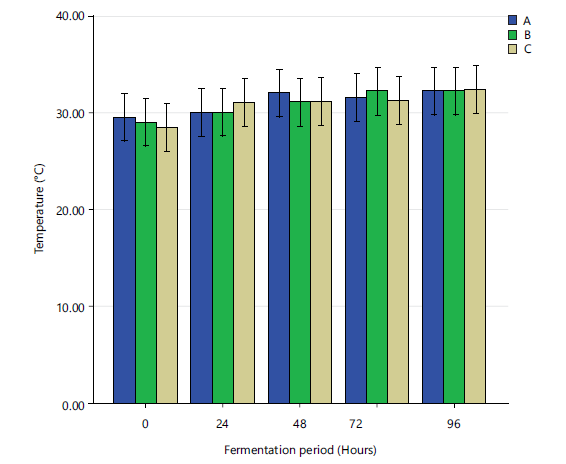
Temperature changes: During the fermentation of sorghum, pigeon pea, and ginger, the samples' temperatures slightly increased from a range of 28.5 to 29.5°C at 0 hrs to 32°C at 96 hrs. This is depicted in Fig. 1.
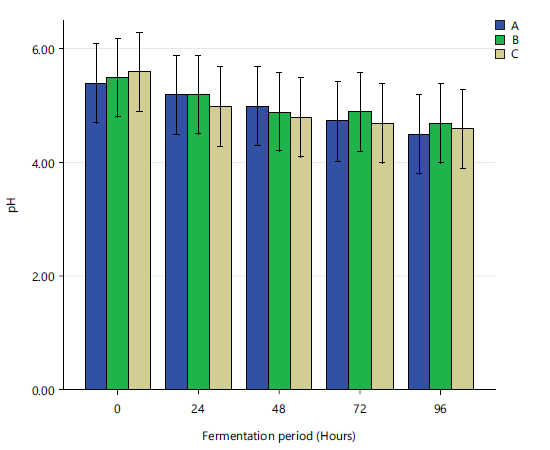
pH changes: Figure 2 illustrates the pH changes during fermentation of sorghum, pigeon pea, and ginger blends. During the fermentation process, the samples' pH reduced from 5.5 to 5.6 at 0 hrs to 4.5 to 4.7 at 96 hrs.
|
|
|
| Table 2: | Bacterial load changes during fermentation of sorghum, pigeon peas, and ginger blends | |||
| Sample | 0 hr | 24 hrs | 48 hrs | 72 hrs | 96 hrs |
| A | 1.03±0.01a | 2.32±0.01c | 2.96±0.01c | 2.24±0.01c | 7.50±0.10b |
| B | 9.90±0.10b | 1.32±0.01a | 1.75±0.01a | 1.02±0.02a | 5.10±0.10a |
| C | 9.70±0.10b | 1.60±0.01b | 2.31±0.01b | 1.57±0.01b | 9.60±0.10c |
| Values are Means±Standard Deviations of three replicates values not followed by the same superscript in the same column are significantly different (p≤0.05), A: Sorghum (100%) B: Sorghum (80%): Pigeon pea (14%): Ginger (6%) C: Sorghum (50%): Pigeon pea (45%): Ginger (5%) | |||||
| Table 3: | Changes in lactic acid bacteria count during fermentation of sorghum, pigeon pea, and ginger blends | |||
| Sample | 0 hr | 24 hrs | 48 hrs | 72 hrs | 96 hrs |
| A | 2.00±0.10a | 1.30±0.10a | 2.70±0.10a | 3.20±0.10a | 3.60±0.10a |
| B | 6.00±0.10c | 2.30±0.10c | 4.80±0.10c | 4.90±0.10b | 5.20±0.10b |
| C | 3.00±0.10b | 1.80±0.10b | 4.40±0.10b | 4.90±0.10b | 5.00±0.10b |
| Values are Means±Standard Deviations of three replicates values not followed by the same superscript in the same column are significantly different (p≤0.05), A: Sorghum (100%) B: Sorghum (80%): Pigeon pea (14%): Ginger (6%) C: Sorghum (50%): Pigeon pea (45%): Ginger (5%) | |||||
| Table 4: | Fungi load during fermentation of sorghum, pigeon pea, and ginger blends | |||
| Sample | 0 hr | 24 hrs | 48 hrs | 72 hrs | 96 hrs |
| A | 1.00±0.10a | 3.00±0.10b | 7.00±0.10b | 9.00±0.10c | 6.00±0.10c |
| B | 4.00±0.10b | 5.00±0.10c | 7.00±0.10b | 8.00±0.10b | 5.00±0.10b |
| C | 7.00±0.10c | 1.40±0.10a | 1.90±0.10a | 2.40±0.10a | 1.70±0.10a |
| Values are Means±Standard Deviations of three replicates values not followed by the same superscript in the same column are significantly different (p≤0.05), A: Sorghum (100%) B: Sorghum (80%): Pigeon pea (14%): Ginger (6%) C: Sorghum (50%): Pigeon pea 45%): Ginger (5%) | |||||
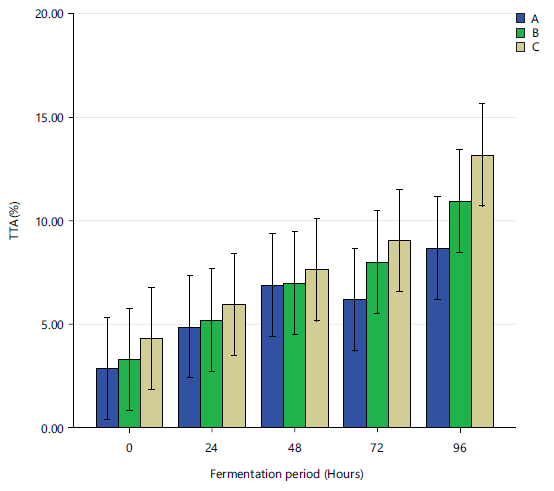
Total titratable acidity changes: The samples' total titratable acidity increased from a range of 2.88 to 4.32 at 0 hrs to 8.73 to a range of 13.23 at 96 hrs during the fermentation process. This is shown in Fig. 3.
The samples' bacterial load first increased between 0 and 48 hrs, then decreased between 72 and 96 hrs. Table 2 illustrates this. The lactic acid bacterial load in the samples increased gradually from zero to 96 hrs. This is illustrated in Table 3. The samples' fungal load first increased between 0 and 72 hrs, then decreased after 96 hrs. This is represented in Table 4.
Paenarthrobacter ilicis, Enterococcus rotai, Liquorilactobacillus sicerae, Limosilactobacillus gastricus, Ligilactobacillus ruminis, Bifidobacterium ramosum, Micrococcus luteus, and Staphylococcus epidermidis are among the eight (8) microorganisms that were conventionally isolated and identified during the fermentation of sorghum, pigeon pea, and ginger blends. Table 5 displays the features of the organisms.
Sorghum, pigeon pea, and ginger blends' proximate composition: Table 6 shows the proximate composition of sorghum, pigeon pea and ginger blends. It was observed that the moisture contents of the raw samples ranged from 15.86±0.04 to 19.07±0.03, whereas those of the fermented samples ranged from 20.88±0.02 to 21.89±0.20.
The ash contents of the raw samples ranged from 1.14±0.04 to 1.51±0.02, whereas the ash contents of the fermented samples ranged from 1.12±0.05 to 1.47±0.02.
Furthermore, the fat contents of the raw samples ranged from 3.48±0.02 to 6.19±0.04, whereas the fermented samples ranged from 2.21±0.03 to 4.67±0.02.
The fibre contents of the raw samples ranged from 2.55±0.02 to 3.00±0.04, whereas the fermented samples ranged from 1.97±0.06 to 2.37±0.02.
| Table 5: | Microorganisms identified during fermentation of sorghum, pigeon pea, and ginger blends | |||
| Probable bacteria | Sucrose | Lactose | Maltose | Glucose | Nitrate reduction |
Hydrogen sulphide |
Starch hydrolysis |
Voges proskaeur |
Methyl red |
Oxidase | Urease | Gas production |
Indole test |
Motility | Spore staining |
Citrate | Catalase | Shapes | Gram staining |
| Paenarthrobacter ilicis | - | + | + | + | - | - | - | - | - | - | + | - | - | - | - | + | + | Cocci | + |
| Enterococcus rotai | + | + | + | + | + | - | - | + | - | - | - | - | - | - | - | - | - | Cocci | + |
| Liquorilactobacillus sicerae | + | + | + | + | - | - | - | + | + | - | - | - | - | + | - | - | - | Rod | + |
| Limosilactobacillus gastricus | + | + | + | + | - | - | - | - | + | - | - | + | - | - | - | + | - | Cooccobacillus | + |
| Ligilactobacillus ruminis | + | + | + | + | - | - | - | - | + | - | - | - | - | + | - | - | - | Rod | + |
| Bifidobacterium ramosum | + | + | - | + | - | - | - | - | + | - | - | - | - | - | - | + | - | Cooccobacillus | + |
| Micrococcus luteus | + | - | + | + | - | + | - | + | - | + | + | - | - | - | + | + | + | Cocci | + |
| Staphylococcus epidermidis | + | + | + | + | + | + | - | + | - | - | + | + | - | + | - | - | + | Cocci | + |
| +: Positive reaction and –: Negative reaction | |||||||||||||||||||
| Table 6: | Proximate composition (moisture, ash, fibre, protein, ether extract, and carbohydrates) of sorghum-pigeon pea-ginger blend samples (RSOA-FSOC) | |||
| Sample | Moisture | Ash | Fibre | Protein | Ether extract | Carbohydrates |
| RSOA | 19.07±0.03c | 1.14±0.04a | 2.55±0.02d | 6.12±0.03b | 3.48±0.02b | 67.85±0.08e |
| RSOB | 18.65±0.02b | 1.47±0.02c | 3.00±0.04f | 9.24±0.03d | 5.50±0.03e | 62.30±0.03c |
| RSOC | 15.86±0.04a | 1.51±0.02c | 2.89±0.02e | 13.51±0.03f | 6.19±0.04f | 60.23±0.03b |
| FSOA | 21.89±0.20f | 1.12±0.05a | 1.97±0.06a | 4.81±0.11a | 2.21±0.03a | 68.48±0.02f |
| FSOB | 21.12±0.04c | 1.35±0.02b | 2.14±0.04b | 7.51±0.02c | 3.95±0.03c | 64.09±0.02d |
| FSOC | 20.88±0.02d | 1.47±0.02c | 2.37±0.02c | 10.03±0.02e | 4.67±0.02d | 60.69±0.02b |
| Values are Means±Standard Deviations of three replicates values not followed by the same superscript in the same column are significantly different (p≤0.05), RSOA: Raw blends of Sorghum (100%) RSOB: Raw blends of Sorghum (80%): Pigeon pea (16%): Ginger (4%) RSOC: Raw blends of Sorghum (50%): Pigeon pea (45%): Ginger (5%) FSOA: Fermented blends of Sorghum (100%) FSOB: Fermented blends of Sorghum (80%): Pigeon pea (16%): Ginger (4%) FSOC: Fermented blends of Sorghum (50%): Pigeon pea (45%): Ginger (5%) | ||||||
| Table 7: | Analysis of the anti-nutrient composition of flour blends made from sorghum, pigeon peas, and ginger | |||
| Sample | Oxalate (mg/g) | Tannin (mg/g) | Saponin (mg/g) | Alkaloids (mg/g) |
| RSOA | 0.73±0.01f | 3.85±1.00b | 11.28±1.00c | 4.92±1.00c |
| RSOB | 0.66±0.01e | 2.97±1.00ab | 8.94±1.00bc | 4.33±1.00bc |
| RSOC | 0.51±0.01c | 2.11±1.00ab | 7.31±1.00ab | 3.75±1.00abc |
| FSOA | 0.54±0.02d | 3.02±1.00ab | 9.13±1.00bc | 3.56±1.00abc |
| FSOB | 0.31±0.01b | 2.24±1.00ab | 6.81±1.00ab | 2.05±1.00ab |
| FSOC | 0.19±0.01a | 1.07±1.00a | 4.90±1.00a | 1.55±1.00a |
| Values are Means±Standard Deviations of three replicates values not followed by the same superscript in the same column are significantly different (p≤0.05), RSOA: Raw blends of Sorghum (100%) RSOB: Raw blends of Sorghum (80%): Pigeon pea (16%): Ginger (4%) RSOC: Raw blends of Sorghum (50%): Pigeon pea (45%): Ginger (5%) FSOA: Fermented blends of Sorghum (100%) FSOB: Fermented blends of Sorghum (80%): Pigeon pea (16%): Ginger (4%) FSOC: Fermented blends of Sorghum (50%): Pigeon pea (45%): Ginger (5%) | ||||
The raw samples had higher protein contents, ranging from 6.12±0.03 to 13.51±0.03, whereas the fermented samples had lower protein contents, ranging from 4.81±0.11 to 10.03±0.02.
The carbohydrate contents of the fermented samples ranged from 60.69±0.02 to 68.48±0.02, whereas the raw samples ranged from 60.23±0.03 to 67.85±0.08.
The analysis of the anti-nutrient composition of flour blends made from sorghum, pigeon peas, and ginger is represented in Table 7. The oxalate contents of the fermented samples ranged from 0.19±0.01 to 0.54±0.02, whereas the oxalate concentrations of the raw samples ranged from 0.51±0.01 to 0.73±0.01. The saponin contents of the fermented samples ranged from 4.90±1.00 to 9.13±1.00, whereas the raw samples ranged from 7.31±1.00 to 11.28±1.00.
The alkaloid contents of the fermented samples ranged from 1.55±1.00 to 3.56±1.00, whereas those of the raw samples ranged from 3.75±1.00 to 4.92±1.00.
The tannin contents of the fermented samples ranged from 1.07±1.00 to 3.02±1.00, whereas the tannin contents of the raw samples ranged from 2.11±1.00 to 3.85±1.00.
DISCUSSION
The study's findings demonstrated a dynamic microbial evolution during the sorghum, pigeon pea, and ginger blends' fermentation phase. The samples' microbial load first increased between 0 and 48 hrs noticeably, indicating an active phase of microbial proliferation. Numerous bacteria, especially lactic acid bacteria (LAB), which thrive in nutrient-rich settings, usually proliferate quickly during this early stage. Numerous bacteria, especially lactic acid bacteria (LAB), which flourish in nutrient-rich media, usually proliferate quickly during this early stage. The rise in microbial population at this point indicates ideal growth conditions, such as accessible carbohydrates, a pH that is mild, and enough oxygen for facultative anaerobes30. However, between 72 and 96 hrs, the bacterial load decreased significantly. The decline can be ascribed to depletion of fermentable substrates and increase of fermentation by-products, including organic acids31. Bacteria metabolize resources, reducing the pH and increasing total titratable acidity (TTA)32. This creates a hostile environment for non-acidophilic microbes. The acidic environment restricts the growth of spoilage organisms and promotes the survival of acid-tolerant species, including some LAB strains33. Additional findings showed a strong correlation between an increase in the viable cell count of LAB and a decrease in pH. Since they can flourish in low-pH conditions, these organisms are known to dominate fermentation ecosystems, and their growth greatly enhances the safety and shelf-life of fermented products34. They significantly increase the blends' microbiological stability by reducing pathogenic and spoilage bacteria through acidity.
In addition to microbial changes, the fermentation technique increased the nutritional content of the blends. Proteins were discovered to be among the vital nutrients that increased as a result of fermentation. This improvement is partially caused by complex substances being broken down into simpler, easier-to-digest forms by enzymes. Concurrently, antinutritional elements such alkaloids, oxalates, tannins, and saponins were greatly diminished after fermentation of the blends. By reducing these substances through microbial enzymatic activity, the nutritional profile of the fermented products is further enhanced. These antinutritional compounds usually impede the absorption and digestion of nutrients35. The fermented samples' decreased ash, fibre, and ether concentrations when compared to the raw blends are comparable to the outcomes of Ojokoh et al.36 fermentation of cowpea and sorghum blends. Microbial activity and the breakdown of complex chemicals are the main causes of reductions in ash, fibre, and ether content during fermentation37.
Similar to the findings of Ojokoh et al.36 during the fermentation of sorghum and cowpea blends, the antinutrient levels, tannin, saponin, and oxalates were likewise significantly lower in the fermented blends compared to the raw blends. Alkaloids, tannins, saponins, and oxalates can be reduced by fermentation for a variety of reasons, including microbial activity that breaks down complex molecules, changes in pH and solubility, and the possibility that fermenting microorganisms will use these compounds for their own growth38. Generally, the fermentation process not only changed the microbial community of the blends but also significantly increased their nutritional content and decreased their anti-nutritional components, making the finished product safer, more stable, and more nutritious.
CONCLUSION
This study shows that fermenting blends of sorghum, pigeon pea, and ginger greatly improves their nutritious value. Through the microbial degradation of complicated chemicals into more digestible forms, fermentation increased the bioavailability and concentration of proximate constituents, such as carbohydrates. Also, it improved nutrient absorption by lowering antinutritional components such oxalates, tannins, saponins, and alkaloids.
These advancements are especially pertinent to the fight against micronutrient deficiencies and protein-energy malnutrition, which are common in developing nations, particularly among vulnerable populations. The inclusion of ginger adds functional benefits due to its antioxidant, anti-inflammatory, and antimicrobial properties. Furthermore, fermentation increased microbiological safety by reducing pH and increasing organic acid synthesis. Generally, fermented blends are an economical, culturally acceptable nutritional mediation capable of increasing dietary quality and promoting food security in resource-constrained environments.
SIGNIFICANCE STATEMENT
This study evaluates the proximate composition and antinutritional contents of flour blends prepared from fermented sorghum and enriched with pigeon pea and ginger to improve the nutritious value of cereal-based products. Despite being commonly ingested, sorghum is limited by low protein quality and the presence of antinutritional chemicals, making the research important. Pigeon pea enrichment boosts protein content, while ginger adds bioactive substances with possible health benefits. Fermentation increases the bioavailability of nutrients and further lowers antinutritional factors. The results from this research will offer scientific proof for creating reasonably priced, nutrient-rich composite flours that are appropriate for supplementary diets and functional foods. As a result, this study promotes greater food utilization, better nutritional outcomes, and the development of value-added products from locally accessible crops.
ACKNOWLEDGMENT
The authors are sincerely grateful to the Head of Department of Biological Sciences and the Technologists in the Department of Chemical Sciences Augustine University Ilara-Epe Lagos State, Nigeria for their equipment and support.
REFERENCES
- Ogwu, M.C., O.O. Aliu and M.E. Osawaru, 2024. Food Crop Utilization and Conservation Techniques in the Global South. In: Food Safety and Quality in the Global South, Ogwu, M.C., S.C. Izah and N.R. Ntuli (Eds.), Springer Nature, Singapore, ISBN: 978-981-97-2428-4, pp: 361-396.
- George, T.T., A.O. Obilana, A.B. Oyenihi, A.B. Obilana, D.O. Akamo and J.M. Awika, 2022. Trends and progress in sorghum research over two decades, and implications for global food security. S. Afr. J. Bot., 151: 960-969.
- Khaskheli, M.A., M.M. Nizamani, E. Tarafder, D. Das and S. Nosheen et al., 2025. Sustainable management of major fungal phytopathogens in sorghum (Sorghum bicolor L.) for food security: A comprehensive review. J. Fungi, 11.
- D’Almeida, C.T.S., M.E.A.S. Oliveira, L.R. da Silva Lima, C.W.P. Carvalho, H. Mameri and M.S.L. Ferreira, 2025. Sorghum. In: Millets: Crops for Climate Resilience and for Food and Nutritional Security, Ceasar, S.A., S. Penna, C.W.P. Carvalho and S.M. Jain (Eds.), Springer Nature, Singapore, ISBN: 978-981-95-1256-0, pp: 239-269.
- Tarannum, N., K. Pooja and R. Agrawal, 2026. Molecular Biology with Nutritional Attributes of Sorghum. In: Millets and Millet Starch: Chemical Composition, Functional Modification, and Applications, Singh, J. and M.K. Malik (Eds.), Springer, Cham, Switzerland, ISBN: 978-3-032-09502-2, pp: 497-528.
- Amusa, N.A. and O.A. Ashaye, 2009. Effect of processing on nutritional, microbiological and sensory properties of kunun-zaki (a sorghum based non-alcoholic beverage) widely consumed in Nigeria. Pak. J. Nutr., 8: 288-292.
- Singh, S., M. Habib, D.J. McClements, K. Bashir, S. Jan and K. Jan, 2024. Exploring the potential of sorghum with reference to its bioactivities, physicochemical properties and potential health benefits. Food Funct., 15: 11847-11864.
- Khalid, W., A. Ali, M.S. Arshad, F. Afzal and R. Akram et al., 2022. Nutrients and bioactive compounds of Sorghum bicolor L. used to prepare functional foods: A review on the efficacy against different chronic disorders. Int. J. Food Prop., 25: 1045-1062.
- Sharma, S., N. Agarwal and P. Verma, 2011. Pigeon pea (Cajanus cajan L.): A hidden treasure of regime nutrition. J. Funct. Environ. Bot. 1: 91-101.
- Ghosh, P.K., K.K. Bandyopadhyay, R.H. Wanjari, M.C. Manna, A.K. Misra, M. Mohanty and A.S. Rao, 2007. Legume effect for enhancing productivity and nutrient use-efficiency in major cropping systems-an Indian perspective: A review. J. Sustainable Agric., 30: 59-86.
- Kushwaha, A. and C.M. Mehta, 2023. Pigeon pea (Cajanus cajan L.) based intercropping system: A review. Int. J. Plant Soil Sci., 35: 1674-1689.
- Abebe, B.K., 2022. The dietary use of pigeon pea for human and animal diets. Sci. World J., 2022.
- Kumar, Y., S. Basu, D. Goswami, M. Devi, U.S. Shivhare and R.K. Vishwakarma, 2022. Anti-nutritional compounds in pulses: Implications and alleviation methods. Legume Sci., 4. https://doi.org/10.1002/leg3.111
- Shoaib, M., A. Shehzad, M.S. Butt, M. Saeed and H. Raza et al., 2016. An overview: Ginger, a tremendous herb. J. Global Innovations Agric. Sci., 4: 172-187.
- Bodagh, M.N., I. Maleki and A. Hekmatdoost, 2019. Ginger in gastrointestinal disorders: A systematic review of clinical trials. Food Sci. Nutr., 7: 96-108.
- Shaukat, M.N., A. Nazir and B. Fallico, 2023. Ginger bioactives: A comprehensive review of health benefits and potential food applications. Antioxidants, 12.
- Kumari, P.V. and N. Sangeetha, 2017. Nutritional significance of cereals and legumes based food mix-a review. Int. J. Agric. Life Sci., 3: 115-122.
- Senanayake, D., P.J. Torley, J. Chandrapala and N.S. Terefe, 2023. Microbial fermentation for improving the sensory, nutritional and functional attributes of legumes. Fermentation, 9.
- Jeyakumar, E. and R. Lawrence, 2022. Microbial Fermentation for Reduction of Antinutritional Factors. In: Current Developments in Biotechnology and Bioengineering: Technologies for Production of Nutraceuticals and Functional Food Products, Rai, A.K., S.P. Singh, A. Pandey, C. Larroche and C.R. Soccol (Eds.), Elsevier, Amsterdam, Netherlands, ISBN: 9780128235065, pp: 239-260.
- Pradhan, A., D. Saha, A. Sarkar and R.K. Rout, 2026. Future Foods: Global Trends, Opportunities, and Sustainability Challenges. In: Sustainable Plant Foods: A Scientific Approach to Alternative Food Sources, Wani, S.A., H.R. Naik and S.A. Ibrahim (Eds.), Elsevier, Amsterdam, Netherlands, ISBN: 978-0-443-31652-4, pp: 245-262.
- Ahmed, Z., 2025. Optimization the nutrient composition and anti-nutrient of cereal-legume mixtures for infant complementary feeding: A review. Am. J. Food Sci. Technol., 4: 60-66.
- Ma, S., Z. Wang, X. Tian, B. Sun and J. Huang et al., 2022. Effect of synergistic fermentation of Lactobacillus plantarum and Saccharomyces cerevisiae on thermal properties of wheat bran dietary fiber-wheat starch system. Food Chem., 373.
- Mishra, S.P. and R.P. Singh, 2024. A pH measurement of acetic acid-sodium acetate buffer solutions using a pH meter at ambient temperature. J. Appl. Chem. Sci. Int., 15: 30-35.
- Dardis, C., E. Bilbao, M.C. Añón and A.G. Abraham, 2026. Fermentation unlocks the functional role of amaranth in modulating wheat/amaranth sourdough microbiota and inhibiting yeast growth of refrigerated doughs. Fermentation, 12.
- Latimer Jr., G.W., 2023. Official Methods of Analysis. 22nd Edn., Oxford University Press, New York, USA, ISBN: 9780197610145.
- Karamad, D., K. Khosravi-Darani, H. Hosseini and S. Tavasoli, 2019. Analytical procedures and methods validation for oxalate content estimation. Biointerface Res. Appl. Chem., 9: 4305-4310.
- Chin, F.S., K.P. Chong, A. Markus and N.K. Wong, 2013. Tea polyphenols and alkaloids content using Soxhlet and direct extraction methods. World J. Agric. Sci., 9: 266-270.
- Batista, R.D., E.R. Asquieri, A.G. de Moura e Silva, R.D. Batista and D.J.M. de Abreu, 2026. Physicochemical characterization of potato peel flour (Solanum tuberosum L.) and optimization of the ultrasound-assisted extraction process (UAE) of the phenolic compounds using response surface methodology. Potato Res., 69.
- Clark, P., G. Ndukwe and K. Awatefe, 2026. Phytochemical characterization and evaluation of antioxidant activity in Sorghum bicolor leaves extracts. Sci. Phytochem., 5: 31-42.
- Yeboah, P.J., S.A. Ibrahim and A. Krastonov, 2023. A review of fermentation and the nutritional requirements for effective growth media for lactic acid bacteria: Media for effective growth of lactic acid bacteria. Food Sci. Appl. Biotechnol., 6: 215-240.
- Omemu, M.A., U.I. Okafor, A.O. Obadina, M.O. Bankole and S.A.O. Adeyeye, 2018. Microbiological assessment of maize of co-fermented with pigeon pea. Food Sci. Nutr., 6: 1238-1253.
- Zheng, Y., P. Chen, E. Wang, Y. Ren and X. Ran et al., 2025. Key enzymatic activities and metabolic pathway dynamics in acidogenic fermentation of food waste: Impact of pH and organic loading rate. J. Environ. Manage., 373.
- Xu, J., L. Guo, N. Zhao, X. Meng and J. Zhang et al., 2023. Response mechanisms to acid stress of acid-resistant bacteria and biotechnological applications in the food industry. Crit. Rev. Biotechnol., 43: 258-274.
- Adesemoye, E.T., A.I. Sanni, G. Spano, V. Capozzi and M. Fragasso, 2025. Lactic acid bacteria diversity in fermented foods as potential bio-resources contributing to alleviate malnutrition in developing countries: Nigeria as a case study. Fermentation, 11.
- Samtiya, M., R.E. Aluko and T. Dhewa, 2020. Plant food anti-nutritional factors and their reduction strategies: An overview. Food Prod. Process. Nutr., 2.
- Ojokoh, A.O., R.A. Alade , P.T. Ozabor and I.F. Fadahunsi, 2020. Effect of fermentation on sorghum and cowpea flour blends. J. Agric. Biotechnol. Sustainable Dev., 12: 39-49.
- Adebo, J.A., P.B. Njobeh, S. Gbashi, A.B. Oyedeji, O.M. Ogundele, S.A. Oyeyinka and O.A. Adebo, 2022. Fermentation of cereals and legumes: Impact on nutritional constituents and nutrient bioavailability. Fermentation, 8.
- Lin, Y., E. Karrar, Shahidul Islam, Z. Jin, U. Muhammad and M. Xu, 2026. Microbial fermentation of cereals: Nutritional, techno-functional, and compositional transformations toward data-driven process optimization. Crit. Rev. Food Sci. Nutr.
How to Cite this paper?
APA-7 Style
Orekoya,
E.S., Ebosetale,
A.S., Ojo,
E.S., Nwose,
A., Bejide,
O.S., Ogunbodede,
A., Okere,
D. (2026). Proximate and Antinutritional Evaluation of Flour Blends from Fermented Sorghum Enriched with Pigeon Pea and Ginger. Asian Journal of Biological Sciences, 19(2), 79-91. https://doi.org/10.3923/ajbs.2026.79.91
ACS Style
Orekoya,
E.S.; Ebosetale,
A.S.; Ojo,
E.S.; Nwose,
A.; Bejide,
O.S.; Ogunbodede,
A.; Okere,
D. Proximate and Antinutritional Evaluation of Flour Blends from Fermented Sorghum Enriched with Pigeon Pea and Ginger. Asian J. Biol. Sci 2026, 19, 79-91. https://doi.org/10.3923/ajbs.2026.79.91
AMA Style
Orekoya
ES, Ebosetale
AS, Ojo
ES, Nwose
A, Bejide
OS, Ogunbodede
A, Okere
D. Proximate and Antinutritional Evaluation of Flour Blends from Fermented Sorghum Enriched with Pigeon Pea and Ginger. Asian Journal of Biological Sciences. 2026; 19(2): 79-91. https://doi.org/10.3923/ajbs.2026.79.91
Chicago/Turabian Style
Orekoya, Elias, Similoluwa, Agbonhese Salome Ebosetale, Emem Shalom Ojo, Adaobi Nwose, Oyeniyi Stephen Bejide, Adedej Ogunbodede, and Daniel Okere.
2026. "Proximate and Antinutritional Evaluation of Flour Blends from Fermented Sorghum Enriched with Pigeon Pea and Ginger" Asian Journal of Biological Sciences 19, no. 2: 79-91. https://doi.org/10.3923/ajbs.2026.79.91

This work is licensed under a Creative Commons Attribution 4.0 International License.
