
Association of Body Mass Index and Lifestyle Factors with Self-Reported Peptic Ulcer Disease among Undergraduate Students: A Cross-Sectional Study
-
Adesua Emmanuel Ogunmokunwa

Department of Human Anatomy, Faculty of Basic Medical Sciences, College of Medicine, Achievers University, Owo, Ondo State, Nigeria
Babatunde Oluwaseun IbitoyeDepartment of Human Anatomy, School of Basic Medical Sciences, College of Health Sciences, Federal University Technology, Akure, Ondo State, Nigeria
Tunde Temidayo ElemosoDepartment of Human Anatomy, Faculty of Basic Medical Sciences, College of Medicine, Achievers University, Owo, Ondo State, Nigeria
Ebennezer Omoyeni LawalDepartment of Human Anatomy, Faculty of Basic Medical Sciences, College of Medicine, Achievers University, Owo, Ondo State, Nigeria
Francis Temitope AdeniranDepartment of Human Anatomy, Faculty of Basic Medical Sciences, College of Medicine, Achievers University, Owo, Ondo State, Nigeria
Tobi Victoria OmotosoDepartment of Human Anatomy, Faculty of Basic Medical Sciences, College of Medicine, Achievers University, Owo, Ondo State, Nigeria
Praise LeonardDepartment of Human Anatomy, Faculty of Basic Medical Sciences, College of Medicine, Achievers University, Owo, Ondo State, Nigeria
| Received 11 Aug, 2026 |
Accepted 10 Oct, 2026 |
Published 31 Dec, 2026 |
Background and Objective: Peptic ulcer disease (PUD) is an important gastrointestinal concern among university students. Evidence regarding the relationship between body mass index (BMI) and PUD remains inconsistent, while Nigerian studies have rarely examined BMI and lifestyle factors concurrently. This study assessed the associations of BMI and lifestyle factors with self-reported PUD diagnosis and symptom burden among undergraduate students of Achievers University, Owo, Nigeria. Materials and Methods: A descriptive cross-sectional study was conducted among 391 undergraduates selected through stratified sampling. Data on sociodemographic characteristics, dietary patterns, stress, sleep, substance use, PUD diagnosis, and symptoms were collected using a structured questionnaire, while anthropometric measurements were obtained directly. Data were analysed using chi-square, independent-samples t-test, one-way analysis of variance, and Spearman's rank correlation in SPSS version 27, with significance set at p<0.05. Results: Normal BMI was observed in 62.4% of participants, while 23.8% reported a previous PUD diagnosis. Diagnosis was higher among females than males (28.9% vs. 14.2%). BMI was not associated with diagnosis (t = -0.603, p = 0.547; χ2 = 1.499, p = 0.683), but symptom scores differed across BMI categories (F = 3.204, p = 0.023), with obese participants reporting the highest burden. Meal-skipping (ρ = 0.360), academic stress (ρ = 0.348), self-medication (ρ = 0.291), and NSAID use (ρ = 0.287) showed the strongest positive correlations with symptom burden. Conclusion: The BMI was not associated with reported PUD diagnosis but was associated with symptom burden. Lifestyle factors showed stronger associations with PUD-related symptoms, highlighting potential targets for university health interventions.
| Copyright © 2026 Ogunmokunwa et al. This is an open-access article distributed under the Creative Commons Attribution License, which permits unrestricted use, distribution, and reproduction in any medium, provided the original work is properly cited. |
INTRODUCTION
Peptic ulcer disease (PUD) is characterised by a mucosal defect in the stomach or proximal duodenum resulting from disruption of the balance between mucosal protective mechanisms and damaging factors, particularly Helicobacter pylori infection and Non-steroidal Anti-Inflammatory Drug (NSAID) use1,2,3. Although the global age-standardised prevalence, mortality, and disability burden of PUD have declined over recent decades, the absolute number of cases remains substantial, with a disproportionate burden in low- and middle-income settings4,5. Recent global estimates also indicate that PUD remains an important cause of gastrointestinal morbidity despite advances in diagnosis and treatment6,7. In Nigeria, university-based studies have reported confirmed or self-reported PUD prevalence ranging from 7.9 to 12.4%, while substantially higher proportions report symptoms suggestive of PUD8,9. These findings indicate a considerable burden of gastrointestinal complaints among university students but also highlight the distinction between symptomatic illness and objectively confirmed PUD.
University students may be particularly exposed to behaviours associated with gastrointestinal symptoms, including irregular meal patterns, late-night eating, consumption of processed foods and caffeinated or carbonated beverages, psychological stress, inadequate sleep, alcohol and tobacco use, and self-medication10,11. Nigerian university studies have similarly identified stress, prolonged periods without food, and dietary practices among commonly reported factors associated with PUD-related complaints8,9. Studies among Nigerian health-professional students have also documented substantial sedentary behaviour and insufficient physical activity, illustrating the broader lifestyle challenges associated with university life12.
Dietary behaviours and food choices have been associated with functional dyspepsia and related upper gastrointestinal symptoms, with evidence from observational studies suggesting that dietary patterns may influence gastrointestinal symptom burden13. The NSAID use is of particular clinical relevance because these drugs impair mucosal defence and remain an established cause of peptic ulceration2. Helicobacter pylori infection remains another major aetiological factor, with current clinical guidelines emphasising its identification and eradication in appropriate patients1,3. However, the contribution of lifestyle behaviours to gastrointestinal symptom burden among Nigerian undergraduates remains insufficiently characterised.
Body Mass Index (BMI) may also be relevant to PUD, although available evidence is inconsistent. A large Taiwanese population study reported that lower obesity indices were associated with PUD, whereas higher obesity indices were associated with gastroesophageal reflux disease14. Conversely, a two-sample Mendelian randomisation study reported evidence supporting a potential causal relationship between higher BMI and peptic ulcer risk, alongside associations with smoking and alcohol consumption15. These contrasting findings suggest that the relationship between body composition and PUD may be complex and population-dependent. Importantly, evidence from these studies is predominantly derived from non-African populations, and the applicability of their findings to young Nigerian adults remains uncertain.
Despite the reported burden of PUD-related symptoms among Nigerian university students, few studies have examined BMI, dietary behaviour, stress, sleep, medication use, and PUD-related symptoms concurrently within the same undergraduate population. This limits understanding of whether BMI is associated with reported PUD diagnosis, symptom burden, or both, and whether lifestyle behaviours demonstrate stronger relationships with these outcomes. The present study therefore assessed the associations of BMI and selected lifestyle factors with self-reported PUD diagnosis and symptom burden among undergraduate students of Achievers University, Owo, Ondo State, Nigeria. Specifically, the study determined the BMI distribution of participants, assessed the prevalence of PUD-related symptoms and reported diagnosis, examined the association between BMI and PUD outcomes, and evaluated the relationships between selected lifestyle factors and PUD diagnosis and symptom burden.
MATERIALS AND METHODS
Study design and setting: A descriptive cross-sectional study was conducted among undergraduate students of Achievers University, Owo, Ondo State, Nigeria, during the 2025/2026 academic session. The study assessed BMI, dietary and eating patterns, stress and sleep, substance and medication use, and self-reported PUD diagnosis and symptoms. The study was reported in accordance with the Strengthening the Reporting of Observational Studies in Epidemiology (STROBE) recommendations for cross-sectional studies16.
Ethical considerations: Ethical approval was obtained from the Achievers University Research Ethics Committee with reference number 0219/2025 before commencement of the study. Written informed consent was obtained from all participants. Participation was voluntary, and confidentiality was maintained using coded questionnaires without personal identifiers.
Study population and sampling: The study population comprised undergraduate students aged 16-30 years across all faculties of the university. From an estimated undergraduate population of 4,168, a minimum sample of 365 was calculated using Yamane's formula, at a 5% margin of error17:
 |
Allowing for 10% attrition, 400 students were targeted. Proportionate stratified sampling was used to recruit students from each faculty, with participants selected across academic levels. Of the 400 students recruited, 391 provided complete questionnaires and anthropometric measurements and were included in the analysis.
Data collection: Data were collected using a structured, self-administered questionnaire that was piloted among students who were not included in the main study. The questionnaire assessed sociodemographic characteristics, dietary and eating patterns, stress and sleep, substance and medication use, and PUD-related symptoms and previous diagnosis. Five symptoms bloating/abdominal discomfort, loss of appetite, burning upper abdominal pain, heartburn/acid reflux, and nausea/vomiting were assessed using a five-point frequency scale (never to always). A composite symptom score was calculated as the mean of the five symptom items.
Weight and height were measured using calibrated digital equipment, with participants barefoot and lightly clothed. BMI was calculated as weight (kg)/height2 (m2) and classified according to standard BMI categories18.
Inclusion and exclusion criteria: Eligible participants were consenting undergraduate students aged 16-30 years who were present during data collection and able to complete the English-language questionnaire. Postgraduate students, university staff, students outside the specified age range, and individuals who declined consent or submitted incomplete questionnaires were excluded.
Statistical analysis: Data were analysed using IBM SPSS Statistics version 27. Descriptive statistics were presented as frequencies, percentages, means, and standard deviations. An independent-samples t-test compared mean BMI between participants with and without reported PUD diagnosis, while the chi-square test assessed associations between BMI categories and diagnosis status. One-way Analysis of Variance compared mean symptom scores across BMI categories. Spearman’s rank correlation assessed associations between lifestyle factors and PUD diagnosis and symptom score. Statistical significance was set at p<0.05.
RESULTS
Socio-demographic and BMI profile: A total of 391 undergraduate students participated. Most respondents were aged 19-24 years (70.3%), and females constituted 63.7% of the sample. Nursing (28.6%) and Medical Laboratory Science (24.8%) contributed the largest proportions of respondents. The mean BMI was 22.31±4.61 kg/m2. Overall, 62.4% of participants had normal weight, 16.6% were underweight, 16.1% were overweight, and 4.9% were obese (Table 1).
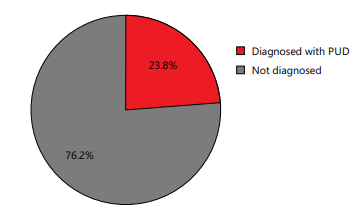
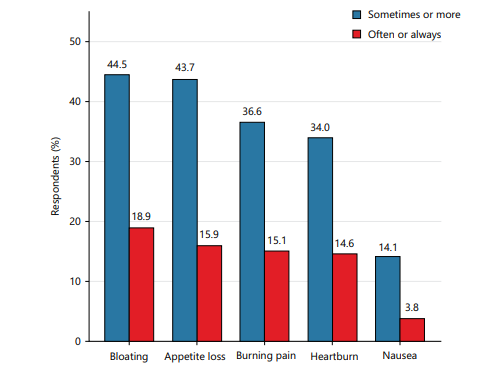
PUD prevalence and symptom burden: Ninety-three participants (23.8%) reported a previous PUD diagnosis by a healthcare professional, compared with 298 (76.2%) who reported no diagnosis. The diagnosis prevalence was higher among females (28.9%) than males (14.2%). Bloating or abdominal discomfort was the most frequently reported symptom (44.5%), followed by loss of appetite (43.7%) and burning upper abdominal pain (36.6%). Only 41.9% of symptomatic participants sought clinical care, while 27.6% ignored their symptoms and 19.9% self-medicated. Overall, 26.1% reported worsening of symptoms since entering university (Fig. 1 and 2).
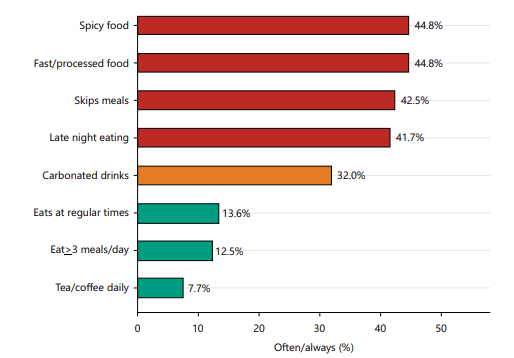
Lifestyle factors: Irregular eating patterns were common, with 42.5% frequently skipping meals because of academic schedules or stress, 44.8% frequently consuming spicy or fast/processed foods, and 41.7% frequently eating after 9:00 p.m. Only 13.6% reported eating at consistent times daily (Fig. 3). Academic stress was frequently reported by 55.5% of participants and examination-related stress by 60.1%. Most students (80.6%) reported sleeping fewer than seven hours per night (Table 2). Smoking and alcohol use were relatively uncommon, whereas self-medication (51.4%) and NSAID use (40.9%) were more frequently reported (Table 2).
BMI and PUD outcomes: Mean BMI did not differ significantly between participants with and without a reported PUD diagnosis (21.75 vs. 22.08 kg/m2; t = -0.603, p = 0.547). BMI category was also not significantly associated with PUD diagnosis (χ2 = 1.499, p = 0.683), nor was continuous BMI correlated with symptom score (ρ = 0.039, p = 0.446). However, symptom scores differed significantly across BMI categories (F = 3.204, p = 0.023), with the highest mean score observed among obese participants (2.57±0.80) (Table 3).
Lifestyle factors and PUD outcomes: Meal-skipping showed the strongest positive correlation with symptom score (ρ = 0.360, p<0.001), followed by academic stress (ρ = 0.348), examination stress (ρ = 0.296), self-medication (ρ = 0.291), NSAID use (ρ = 0.287), sleep difficulty due to stress (ρ = 0.268), and late-night eating (ρ = 0.171). Regular meal timing was negatively correlated with symptom score (ρ = -0.146, p = 0.004).
| Table 1: | BMI category distribution (N = 391) | |||
| BMI category | n | % |
| Underweight (<18.5) | 65 | 16.6 |
| Normal (18.5-24.9) | 244 | 62.4 |
| Overweight (25.0-29.9) | 63 | 16.1 |
| Obese (≥30.0) | 19 | 4.9 |
| Table 2: | Stress, sleep, and substance use frequencies (N = 391) | |||
| Variable | Often/Always or sometimes+ (%) |
| Exam stress is high | 60.1 |
| Academic stress (frequent) | 55.5 |
| Sleep difficulty due to stress | 30.4 |
| Sleeps <7 hrs nightly | 80.6 |
| Self-medication (≥sometimes) | 51.4 |
| NSAID use (any frequency) | 40.9 |
| Alcohol (≥sometimes) | 23 |
| Cigarette/tobacco (ever) | 5.1 |
|
|
| Table 3: | BMI versus PUD-statistical test summary (N = 391) | |||
| Test | Statistic | df | p-value |
| t-test (BMI: PUD vs no PUD) | t = -0.603 | 389 | 0.547 |
| Chi-square (BMI category×PUD) | χ2 = 1.499 | 3 | 0.683 |
| Spearman ρ (BMI×symptom score) | ρ = +0.039 | - | 0.446 |
| ANOVA (BMI category×symptom score) | F = 3.204 | 3, 387 | 0.023* |
| BMI: Body mass index, PUD: Peptic ulcer disease, df: Degrees of freedom. The t-test compares mean BMI between participants with and without PUD. The Chi-square test assesses the association between BMI categories and PUD status. Spearman’s correlation assesses the relationship between BMI and symptom score. ANOVA compares mean symptom scores across BMI categories and *p<0.05 indicates statistical significance | |||
For reported PUD diagnosis, significant positive correlations were observed with sleep difficulty (ρ = .176, p<.001) and academic stress (ρ = 0.169, p<.001), while carbonated-drink consumption showed a weak negative correlation (ρ = -0.127, p = 0.012). Spicy food, alcohol, fast food, and tea/coffee were not significantly associated with either outcome (Table 4; Fig. 3).
Ranked Spearman correlations between lifestyle factors and PUD symptom score (N = 391).
|
| Table 4: | Spearman correlations-lifestyle factors versus PUD diagnosis and symptom score (N = 391) | |||
| Lifestyle factor | ρ (diagnosis) | p | ρ (symptom score) | p |
| Meal-skipping | 0.003 | 0.958 | 0.36 | <0.001*** |
| Academic stress | 0.169 | 0.0008*** | 0.348 | <0.001*** |
| Exam stress | 0.058 | 0.253 | 0.296 | <0.001*** |
| Self-medication | - | - | 0.291 | <0.001*** |
| NSAID use | 0.046 | 0.366 | 0.287 | <0.001*** |
| Sleep difficulty (stress) | 0.176 | 0.0005*** | 0.268 | <0.001*** |
| Late-night eating | 0.058 | 0.255 | 0.171 | 0.001*** |
| Eating at regular times | -0.068 | 0.179 | -0.146 | 0.004** |
| Fast/processed food | -0.079 | 0.118 | 0.08 | 0.114 |
| Carbonated drinks | -0.127 | 0.012* | 0.064 | 0.204 |
| Alcohol | -0.007 | 0.891 | 0.063 | 0.213 |
| Smoking | 0.079 | 0.121 | - | - |
| *p<0.05, **p<0.01, ***p<0.001 and ns: Not significant | ||||
| Table 5: | Comparison of PUD prevalence and sex distribution across Nigerian University Studies | |||
| Study | Sample | PUD prevalence | % Female cases |
| Present study | N = 391, Achievers University, Owo | 23.8% (diagnosis) | 77.40% |
| Bodunde et al.9 | N = 340, Lead City University, Ibadan | 12.4% (self-report) | 87.80% |
Comparison with previous Nigerian university studies: The prevalence and sex distribution observed in the present study are compared with findings from previous Nigerian university studies in Table 5. The 23.8% self-reported diagnosis prevalence was higher than previously reported estimates, although differences in diagnostic definitions and ascertainment methods limit direct comparison.
DISCUSSION
The present study recorded a 23.8% prevalence of self-reported previous PUD diagnosis among undergraduate students (Fig. 1). This was higher than the 12.4% reported among students of a private university in Ibadan and the 7.9% confirmed prevalence reported in another Nigerian university8,9 (Table 5). The difference should be interpreted cautiously because of variations in case ascertainment. The present study relied on self-reported previous diagnosis, whereas the 7.9% estimate reported by Anaemene and Ochogu8 represented confirmed PUD. The higher frequency of symptoms than confirmed disease in previous Nigerian students further demonstrates that symptom burden and diagnosed PUD are not interchangeable outcomes. Gastrointestinal symptoms alone cannot reliably establish PUD because they may arise from several upper gastrointestinal disorders2. The predominance of females among participants reporting PUD (77.4%) was also comparable with the female predominance reported by Bodunde et al.9 (Table 5), although this finding may reflect differences in reporting and healthcare-seeking behaviour rather than a biological sex effect.
The BMI was distributed across all major weight categories (Table 1), but neither mean BMI nor BMI category was significantly associated with reported PUD diagnosis (Table 3). This suggests that BMI alone was not an important discriminator of reported PUD in this population. The finding is consistent with the heterogeneous evidence concerning adiposity and PUD. Chen et al.14 reported an association between lower obesity indices and PUD, whereas Liu et al.15, using Mendelian randomization, reported an association between genetically predicted higher BMI and ulcer risk. In the present study, however, BMI category was significantly associated with symptom burden, with obese participants recording the highest mean symptom scores (Table 4). Thus, BMI appeared to relate more closely to symptom severity than reported diagnostic status, although the cross-sectional design prevents causal interpretation.
A substantial burden of gastrointestinal symptoms and irregular eating behaviours was observed (Fig. 1-2). Meal-skipping was the strongest lifestyle correlate of symptom score, while academic and examination-related stress, self-medication, NSAID use, and sleep difficulty also showed important associations (Table 4; Fig. 3). These findings are broadly consistent with Nigerian university studies reporting stress and irregular eating among factors associated with PUD-related complaints8,9. The university environment may contribute to these behaviours through academic schedules, examinations, and competing demands. Nevertheless, these associations should not be interpreted as evidence that meal-skipping or stress directly causes ulcer formation.
The relationship between NSAID use and symptom burden is particularly relevant because NSAIDs are an established cause of peptic ulceration through disruption of gastric mucosal defence2. Helicobacter pylori infection is another major cause of PUD globally, and its substantial prevalence reinforces the importance of considering established clinical risk factors alongside lifestyle characteristics3,19,20. Because H. pylori infection was not assessed in the present study, its contribution to the observed diagnosis prevalence and symptom burden could not be determined. Similarly, the absence of significant associations for smoking, alcohol, and some dietary variables should not be interpreted as evidence of no effect; the low prevalence of some exposures may have limited statistical power (Table 2, 4).
The correlation analysis demonstrated that lifestyle variables generally showed stronger relationships with symptom score than with reported PUD diagnosis (Table 4). This distinction is important and suggests that some lifestyle behaviours may influence gastrointestinal symptom expression without necessarily determining whether an individual has a clinically diagnosed ulcer. Regular meal consumption was associated with lower symptom burden, whereas meal-skipping showed the strongest positive association. These findings provide a potentially useful basis for student health interventions, although they should be regarded as behavioural associations rather than demonstrated protective or causal effects.
The findings should be interpreted in light of the study's limitations. The cross-sectional design prevents assessment of temporality or causality, while reliance on self-reported diagnosis may have resulted in misclassification. The absence of objective PUD confirmation and H. pylori testing also limits interpretation of the reported prevalence. Furthermore, the single-university setting limits generalizability. Despite these limitations, the study provides a useful integrated assessment of BMI, lifestyle behaviours, reported PUD diagnosis, and symptom burden among Nigerian undergraduates (Table 5).
CONCLUSION
The BMI was not significantly associated with reported PUD diagnosis but was associated with symptom burden, whereas meal-skipping, stress, self-medication, NSAID use, and sleep difficulty demonstrated stronger relationships with gastrointestinal symptoms. These findings suggest that BMI and lifestyle factors may relate differently to diagnostic status and symptom expression. Future multicentre longitudinal studies incorporating objective PUD assessment, H. pylori testing, and detailed measurement of NSAID exposure are warranted to clarify these relationships and determine their generalizability to Nigerian university populations.
SIGNIFICANCE STATEMENT
This study demonstrates that BMI was not associated with self-reported peptic ulcer disease diagnosis but was associated with symptom burden among university students. Meal-skipping, academic stress, self-medication, and NSAID use showed stronger relationships with symptoms, highlighting modifiable lifestyle factors that may inform targeted health education and preventive interventions in university settings.
REFERENCES
- Rasmi, Y., M. Sadreddini, M. Jamali, T. Peirouvi and F. Khosravifar, 2009. Frequency of cytotoxin associated gene A(+)Helicobacter pylori in peptic ulcer disease: Difference between gastric and duodenal ulcer disease. J. Med. Sci., 9: 146-150.
- Vakil, N., 2024. Peptic ulcer disease: A review. JAMA, 332: 1832-1842.
- Chey, W.D., C.W. Howden, S.F. Moss, D.R. Morgan, K.B. Greer, S. Grover and S.C. Shah, 2024. ACG clinical guideline: Treatment of Helicobacter pylori infection. Am. J. Gastroenterol., 119: 1730-1753.
- Xie, X., K. Ren, Z. Zhou, C. Dang and H. Zhang, 2022. The global, regional and national burden of peptic ulcer disease from 1990 to 2019: A population-based study. BMC Gastroenterol., 22.
- Ren, J., X. Jin, J. Li, R. Li and Y. Gao et al., 2022. The global burden of peptic ulcer disease in 204 countries and territories from 1990 to 2019: A systematic analysis for the Global Burden of Disease Study 2019. Int. J. Epidemiol., 51: 1666-1676.
- Wang, S., T. Zhang, D. Li and X. Cao, 2025. The global, regional and national burden of peptic ulcer disease attributable to smoking from 1990 to 2021: A population-based study. Preventive Med. Rep., 51.
- Gong, J., K. Zhang, J.W. Yan, X.X. Zhang and J. Liu, 2026. Global burden of peptic ulcer disease (1990-2021) and projections to 2050: A comprehensive analysis of age, sex, and socioeconomic disparities. Curr. Med. Sci., 46: 1023-1037.
- Anaemene, D.I. and E.U. Ochogu, 2022. Prevalence, symptoms and lifestyle aspect of peptic ulcer disease among undergraduate students of a Nigerian university. Afr. J. Biomed. Res., 25: 129-133.
- Bodunde, I.O., E.O. Aleru and G.D. Oluwafemi, 2025. Prevalence of peptic ulcer disease and dietary pattern among students of a private university in Nigeria. N. Afr. J. Food Nutr. Res., 9: 249-256.
- Al-Jawarneh, M., S. Chauhan, I. Csölle and S. Lohner, 2025. The association of unhealthy eating behaviors with sleep quality outcomes among university students: A cross-sectional study. Nutrients, 17.
- Erem, S. and D. Eren, 2025. Relationship between food addiction, night eating syndrome and depression level in university students and affecting factors: A cross-sectional study in Türkiye. Food Sci. Nutr., 13.
- Oyeyemi, A.L., S. Muhammed, A.Y. Oyeyemi and B.O.A. Adegoke, 2017. Patterns of objectively assessed physical activity and sedentary time: Are Nigerian health professional students complying with public health guidelines? PLoS ONE, 12.
- Ostadsharif, N., F. Haghighatdoost, M.A. Forooshani, P. Hajihashemi and P. Adibi, 2026. Association between dietary habits and risk of functional dyspepsia: A systematic review and meta-analysis of observational data. J. Health Popul. Nutr., 45.
- Chen, C.C., J.H. Geng, P.Y. Wu, J.C. Huang, H.M. Hu, S.C. Chen and C.H. Kuo, 2024. High obesity indices are associated with gastroesophageal reflux disease, but low obesity indices are associated with peptic ulcer disease in a large Taiwanese population study. Obes. Facts, 17: 491-501.
- Liu, Y., Z. Xiao, K. Ye, L. Xu and Y. Zhang, 2023. Smoking, alcohol consumption, diabetes, body mass index, and peptic ulcer risk: A two-sample Mendelian randomization study. Front. Genet., 13.
- von Elm, E., D.G. Altman, M. Egger, S.J. Pocock, P.C. Gotzsche and J.P. Vandenbroucke, 2007. The Strengthening the Reporting of Observational Studies in Epidemiology (STROBE) statement: Guidelines for reporting observational studies. Prev. Med., 45: 247-251.
- Yamane, T., 1967. Statistics: An Introductory Analysis. 2nd Edn., Harper and Row, New York, Pages: 919.
- WHO, 2000. Obesity: Preventing and Managing the Global Epidemic. World Health Organization, Geneva, Switzerland, ISBN-13: 9789241208949, Pages: 253.
- Malfertheiner, P., M.C. Camargo, E. El-Omar, J.M. Liou and R. Peek et al., 2023. Helicobacter pylori infection. Nat. Rev. Dis. Primers, 9.
- Akinpelu, O.O., H.S. Samuel, D.A. Undie, F.A. Ibekwe, O.P. Onotu and E.E. Etim, 2026. Current concepts of Helicobacter pylori infection. Eur. J. Med. Res., 31.
How to Cite this paper?
APA-7 Style
Ogunmokunwa,
A.E., Ibitoye,
B.O., Elemoso,
T.T., Lawal,
E.O., Adeniran,
F.T., Omotoso,
T.V., Leonard,
P. (2026). Association of Body Mass Index and Lifestyle Factors with Self-Reported Peptic Ulcer Disease among Undergraduate Students: A Cross-Sectional Study. Asian Journal of Biological Sciences, 19(4), 125-133. https://doi.org/10.3923/ajbs.2026.125.133
ACS Style
Ogunmokunwa,
A.E.; Ibitoye,
B.O.; Elemoso,
T.T.; Lawal,
E.O.; Adeniran,
F.T.; Omotoso,
T.V.; Leonard,
P. Association of Body Mass Index and Lifestyle Factors with Self-Reported Peptic Ulcer Disease among Undergraduate Students: A Cross-Sectional Study. Asian J. Biol. Sci 2026, 19, 125-133. https://doi.org/10.3923/ajbs.2026.125.133
AMA Style
Ogunmokunwa
AE, Ibitoye
BO, Elemoso
TT, Lawal
EO, Adeniran
FT, Omotoso
TV, Leonard
P. Association of Body Mass Index and Lifestyle Factors with Self-Reported Peptic Ulcer Disease among Undergraduate Students: A Cross-Sectional Study. Asian Journal of Biological Sciences. 2026; 19(4): 125-133. https://doi.org/10.3923/ajbs.2026.125.133
Chicago/Turabian Style
Ogunmokunwa, Adesua, Emmanuel, Babatunde Oluwaseun Ibitoye, Tunde Temidayo Elemoso, Ebennezer Omoyeni Lawal, Francis Temitope Adeniran, Tobi Victoria Omotoso, and Praise Leonard.
2026. "Association of Body Mass Index and Lifestyle Factors with Self-Reported Peptic Ulcer Disease among Undergraduate Students: A Cross-Sectional Study" Asian Journal of Biological Sciences 19, no. 4: 125-133. https://doi.org/10.3923/ajbs.2026.125.133

This work is licensed under a Creative Commons Attribution 4.0 International License.
